Learning Urdu – Agha Shahid Ali
In Kashmir, where the year
has four, clear seasons, my mother
spoke of her childhood
in the plains of Lucknow, and
of that season in itself,
the monsoon, when Krishna’s
flute is heard on the shores
of the Jamuna. She played old records
of the Banaras thumri-singers,
Siddheshwari and Rasoolan, their
voices longing, when the clouds
gather, for that invisible
blue god. Separation
can’t be borne when the rains
come: this every lyric says.
While children run out
into the alleys, soaking
their utter summer,
messages pass between lovers.
Heer and Ranjha and others
of legends, their love forbidden,
burned incense all night,
waiting for answers. My mother
hummed Heer’s lament
but never told me if she
also burned sticks
of jasmine that, dying,
kept raising soft necks
of ash. I imagined
each neck leaning
on the humid air. She only
said: The monsoons never cross
the mountains into Kashmir.
– Agha Shahid Ali
And to honour his mother’s memory, here are the two greats – Siddheshwari Devi and Rasoolan Bai– in a rare recording, singing together.
(after Ghalib)
Just a few return from dust, disguised as roses.
What hopes the earth forever covers, what faces?
I too could recall moonlit roofs, those nights of wine—
But Time has shelved them now in Memory’s dimmed places.
She has left forever, let blood flow from my eyes
till my eyes are lamps lit for love’s darkest places.
All is his—Sleep, Peace, Night—when on his arm your hair
shines to make him the god whom nothing effaces.
With wine, the palm’s lines, believe me, rush to Life’s stream—
Look, here’s my hand, and here the red glass it raises.
See me! Beaten by sorrow, man is numbed to pain.
Grief has become the pain only pain erases.
World, should Ghalib keep weeping you will see a flood
drown your terraced cities, your marble palaces.
– Agha Shahid Ali
This, again, is not a translation but a tip of the hat to Ghalib’s ghazal:
Chances are that Ali would be more familiar with the Begum Akhtar version, introduced here by Kaifi Azmi, on Ghalib’s 100th death anniversary:
Though a slightly younger generation perhaps would know it better in Jagjit Singh’s voice:
The text and translation below is from Frances Pritchett’s excellent site.
sab kahāñ kuchh lālah-o-gul meñ numāyāñ ho gaʾīñ
ḳhāk meñ kyā ṣūrateñ hoñgī kih pinhāñ ho gaʾīñ
Not all but some faces were able to become manifest in the form of tulips and roses
How many more faces there must be that became hidden
yād thīñ ham ko bhī rangārang bazm-ārāʾiyāñ
lekin ab naqsh-o-nigār-e t̤āq-e nisyāñ ho gaʾīñ
we too remembered colourful party-adornings
but now they have become ornaments in the niche of forgetfulness
thīñ banāt ul-naʿsh-e gardūñ din ko parde meñ nihāñ
shab ko un ke jī meñ kyā āʾī kih ʿuryāñ ho gaʾīñ
the Daughters of the Bier of the heavens were hidden, by day, in pardah
at night, what came into their inner-self, that they became naked?
qaid meñ yaʿqūb ne lī go nah yūsuf kī ḳhabar
lekin āñkheñ rauzan-e dīvār-e zindāñ ho gaʾīñ
although Jacob didn’t get news of Joseph in prison
still, his eyes became crevice-work in the wall of the cell
sab raqīboñ se hoñ nā-ḳhvush par zanān-e miṣr se
hai zulaiḳhā ḳhvush kih maḥv-e māh-e kanʿāñ ho gaʾīñ
all [lovers] may be unhappy with Rivals, but with the women of Egypt
Zulaikha is happy, in that they became absorbed in the Moon of Canaan [Joseph]
jū-e ḳhūñ āñkhoñ se bahne do kih hai shām-e firāq
maiñ yih samjhūñgā kih shamʿeñ do furozāñ ho gaʾīñ
let a stream of blood flow from the eyes, for it’s the evening/night of separation
I will consider that two candles have become radiant/illuminated
in parīzādoñ se leñge ḳhuld meñ ham intiqām
qudrat-e ḥaq se yihī ḥūreñ agar vāñ ho gaʾīñ
we will take revenge in Paradise on these Pari-born ones
if through the power of Justice/right/God, only/emphatically they would there become Houris
nīnd us kī hai dimāġh us kā hai rāteñ us kī haiñ
terī zulfeñ jis ke bāzū par pareshāñ ho gaʾīñ
sleep is his, spirit/pride/’head’ is his, the nights are his
on whose shoulder your curls became scattered/tangled
maiñ chaman meñ kyā gayā goyā dabistāñ khul gayā
bulbuleñ sun kar mire nāle ġhazal-ḳhvāñ ho gaʾīñ
I hardly went into the garden!– [rather], so to speak, a school opened
the Nightingales, having heard my laments, became ghazal-{reciting/reciters}
vuh nigāheñ kyūñ huʾī jātī haiñ yā rab dil ke pār
jo mirī kotāhī-e qismat se mizhgāñ ho gaʾīñ
why do those glances, oh Lord, keep going through/beyond the heart?
[those glances] which, through my shortfall of fortune, became eyelashes
baskih rokā maiñ ne aur sīne meñ ubhrīñ pai bah pai
merī āheñ baḳhyah-e chāk-e garebāñ ho gaʾīñ
1a) although I stopped them, more/others welled up one after another in the breast
1b) I stopped them to such an extent– and they welled up one after another in the breast
2) my sighs became the stitching-up of the tearing of the collar
vāñ gayā bhī maiñ to un kī gāliyoñ kā kyā javāb
yād thīñ jitnī duʿāʾeñ ṣarf-e darbāñ ho gaʾīñ
1) even if I would go there, then what answer [would there be] for her insults?
2) as many blessings/supplications as I remembered, became expended on the Doorkeeper
jāñ-fizā hai bādah jis ke hāth meñ jām ā gayā
sab lakīreñ hāth kī goyā rag-e jāñ ho gaʾīñ
1) wine is life-{increasing/enhancing}; in whomever’s hand the glass came
2) all the lines of[his hand became, so to speak, the jugular vein
ham muvaḥḥid haiñ hamārā kesh hai tark-e rusūm
millateñ jab miṭ gaʾīñ ajzā-e īmāñ ho gaʾīñ
1) we are {a monotheist / monotheists}, our faith/sect/practice is the renunciation of customs/laws
2) when religions/groups were erased, they became parts of belief/faith/integrity
ranj se ḳhū-gar huʾā insāñ to miṭ jātā hai ranj
mushkileñ mujh par paṛīñ itnī kih āsāñ ho gaʾīñ
1) if a person would become accustomed to grief, then grief is erased
2) so many difficulties fell upon me, that they became easy
yūñ hī gar rotā rahā ġhālib to ay ahl-e jahāñ
dekhnā in bastiyoñ ko tum kih vīrāñ ho gaʾīñ
1) if Ghalib would keep on weeping {like this / for no reason}, then, oh people of the world
2) you just look at these towns– that they’ve become desolate
ranjish hī sahī dil hī dukhāne ke liye aa
aa phir se mujhe chhoḌ ke jaane ke liye aa
kuchh to mire pindār-e-mohabbat kā bharam rakh
tū bhī to kabhī mujh ko manāne ke liye aa
pahle se marāsim na sahī phir bhī kabhī to
rasm-o-rah-e-duniyā hī nibhāne ke liye aa
kis kis ko batā.eñge judā.ī kā sabab ham
tū mujh se ḳhafā hai to zamāne ke liye aa
ik umr se huuñ lazzat-e-girya se bhī mahrūm
ai rāhat-e-jāñ mujh ko rulāne ke liye aa
ab tak dil-e-ḳhush-fahm ko tujh se haiñ ummīdeñ
ye āḳhirī sham.eñ bhī bujhāne ke liye aa .
A newage version:
At Purana Qila I am alone, waiting
for the bus to Daryaganj. I see it coming,
but my hands are empty.
“,Jump on, jump on,” someone shouts,
“I’ve saved this change for you
for years. Look!”
A hand opens, full of silver rupees.
“Jump on, jump on.” The voice doesn’t stop.
There’s no one I know. A policeman,
handcuffs silver in his hands,
asks for my ticket.
I jump off the running bus,
sweat pouring from my hair.
I run past the Doll Museum, past
headlines on the Times of India
building, prisoners blinded in a bihar
jail, harijan villages burned by landlords.
Panting, I stop in Daryaganj,
outside Golcha Cinema.
Sunil is there, lighting
a cigarette, smiling. I say,
“It must be ten years, you haven’t changed,
it was your voice on the bus!”
He says, “The film is about to begin,
I’ve bought an extra ticket for you,”
and we rush inside:
Anarkali is being led away,
her earrings lying on the marble floor.
Any moment she’ll be buried alive.
“But this is the end,” I turn
toward Sunil. He is nowhere.
The usher taps my shoulder, says
my ticket is ten years old.
Once again my hands are empty.
I am waiting, alone, at Purana Qila.
Bus after empty bus is not stopping.
Suddenly, beggar women with children
are everywhere, offering
me money, weeping for me.
– Agha Shahid Ali
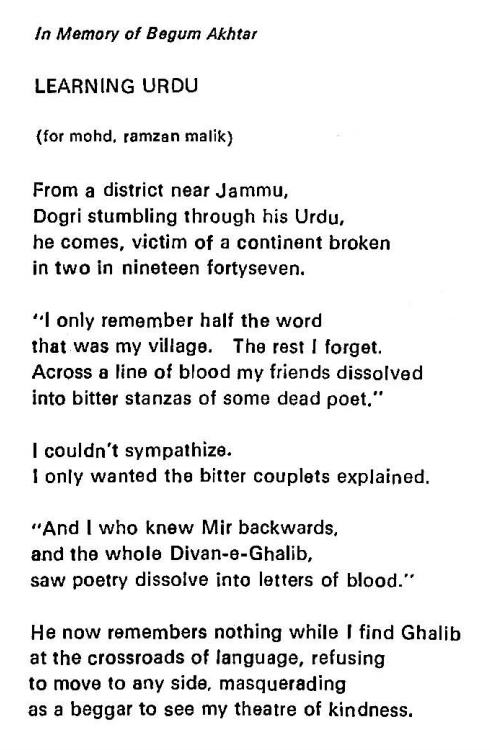
From a district near Jammu,
(Dogri stumbling through his Urdu)
he comes, the victim of a continent broken
in two in nineteen forty-seven.
He mentions the minced air he ate
while men dissolved in alphabets
of blood, in syllables of death, of hate.
‘I only remember half the word
that was my village. The rest I forget.
My memory belongs to the line of blood
across which my friends dissolved
into bitter stanzas of some dead poet.’
He wanted me to sympathise. I couldn’t,
I was only interested in the bitter couplets
which I wanted him to explain. He continued,
‘And I who knew Mir backwards, every
couplet from the Diwan-e-Ghalib saw poetry
dissolve into letters of blood.’ He
Now remembers nothing while I find Ghalib
at the crossroads of language, refusing
to move to any side, masquerading
as a beggar to see my theatre of kindness.
– Agha Shahid Ali
Next to Saffron cultivation in interest come the floating gardens
Of the Dal Lake that can be towed from place to place.
1.
I will die, in autumn, in Kashmir,
and the shadowed routine of each vein
will almost be news, the blood censored,
for the Saffron Sun and the Times of Rain
will be sold in black, then destroyed,
invisibly at Zero Taxi Stand.
There will be men nailing tabloids
to the fence of Grindlay’s Bank,
I will look for any sign of blood
in captions under the photos of boys,
those who by inches – after the April flood –
were killed in fluted waters, each voice
torn from its throat as the Jehlum
receded to their accounts and found cash
sealed in the bank’s reflection.
I will open the waves, draw each hushed
balance, ready to pay, by any means,
whatever the drivers ask. The tone
called Eyes of Maple Green
will promise, “I’ll take you anywhere, even
in curfew hours,” and give me a bouquet –
“There’s a ban on wreaths!”
2.
I will die that day in late October, it will be long ago:
He will take me to Pompore where I’ll gather flowers and run
back to the taxi, stamens – How many thousands? – crushed
to red varnish in my hands: I’ll shout: “Saffron, my payment!”
And he’ll break the limit, chase each rumor of me. “No one’s
see Shahid,” we’ll hear again and again, in every tea house from
Nishat to Naseem. He will stop by the Shalimar ghat, and we’ll
descend the steps to the water. He’ll sever some land – two
yards – from the shore, I, his last passenger. Suddenly he’ll age,
his voice will break, his gaze green water, washing me: “it won’t
grow again, this gold from the burned fields of Pampore.” And
he will row the freed earth past the Security zones, so my blood
is news in the Saffron Sun setting on the waves.
3.
Yes, I remember it,
the day I’ll die, I broadcast the crimson,
so long of that sky, its spread air,
its rushing dyes, and a piece of earth
bleeding, apart from the shore, as we went
on the day I’ll die, past the guards, and he,
two yards he rowed me into the sunset,
past all pain. On everyone’s lips was news
of my death but only that beloved couplet,
broken, on his:
“If there is a paradise on earth,
It is this, it is this, it is this.”
(for Vidur Wazir)
– Agha Shahid Ali
At a certain point I lost track of you.
They make a desolation and call it peace.
when you left even the stones were buried:
the defenceless would have no weapons.
When the ibex rubs itself against the rocks,
who collects its fallen fleece from the slopes?
O Weaver whose seams perfectly vanished,
who weighs the hairs on the jeweller’s balance?
They make a desolation and call it peace.
Who is the guardian tonight of the Gates of Paradise?
My memory is again in the way of your history.
Army convoys all night like desert caravans:
In the smoking oil of dimmed headlights, time dissolved- all
winter- its crushed fennel.
We can’t ask them: Are you done with the world?
In the lake the arms of temples and mosques are locked in each other’s
reflections.
Have you soaked saffron to pour on them when they are found like this
centuries later in this country
I have stitched to your shadow?
In this country we step out with doors in our arms
Children run out with windows in their arms.
You drag it behind you in lit corridors.
if the switch is pulled you will be torn from everything.
At a certain point I lost track of you.
You needed me. You needed to perfect me.
In your absence you polished me into the Enemy.
Your history gets in the way of my memory.
I am everything you lost. You can’t forgive me.
I am everything you lost. Your perfect Enemy.
Your memory gets in the way of my memory:
I am being rowed through Paradise in a river of Hell:
Exquisite ghost, it is night.
The paddle is a heart; it breaks the porcelain waves.
It is still night. The paddle is a lotus.
I am rowed- as it withers-toward the breeze which is soft as
if it had pity on me.
If only somehow you could have been mine, what wouldn’t
have happened in the world?
I’m everything you lost. You won’t forgive me.
My memory keeps getting in the way of your history.
There is nothing to forgive.You can’t forgive me.
I hid my pain even from myself; I revealed my pain only to myself.
There is everything to forgive. You can’t forgive me.
If only somehow you could have been mine,
what would not have been possible in the world?
– Agha Shahid Ali
. . . letters sent
To dearest him that lives alas! away.
– Gerard Manley Hopkins
1
Again I’ve returned to this country
where a minaret has been entombed.
Someone soaks the wicks of clay lamps
in mustard oil, each night climbs its steps
to read messages scratched on planets.
His fingerprints cancel blank stamps
in that archive for letters with doomed
addresses, each house buried or empty
Empty? Because so many fled, ran away,
and became refugees there, in the plains,
where they must now will a final dewfall
to turn the mountains to glass. They’ll see
us through them see us frantically bury
houses to save them from fire that, like a wall,
caves in. The soldiers light it, hone the flames,
burn our world to sudden papier-mâché
inlaid with gold, then ash. When the muezzin
died, the city was robbed of every Call.
The houses were swept about like leaves
for burning. Now every night we bury
our houses and theirs, the ones left empty.
We are faithful. On their doors we hang wreaths.
More faithful each night fire again is a wall
and we look for the dark as it caves in.
2
We’re inside the fire, looking for the dark,
one unsigned card, left on the street, says. I want
to be he who pours blood. To soak your hands.
Or I’ll leave mine in the cold till the rain
is ink, and my fingers, at the edge of pain,
are seals all night to cancel the stamps.
The mad guide! The lost speak like this. They haunt
a country when it is ash. Phantom heart,
pray he’s alive. I have returned in rain
to find him, to learn why he never wrote.
I’ve brought cash, a currency of paisleys
to buy the new stamps, rare already, blank,
to buy the new stamps, rare already, blank,
no nation named on them. Without a lamp
I look for him in houses buried, empty
He may be alive, opening doors of smoke,
breathing in the dark his ash-refrain:
Everything is finished, nothing remains.
I must force silence to be a mirror
to see his voice, ask it again for directions.
Fire runs in waves. Should I cross that river?
Each post office is boarded up. Who will deliver
parchment cut in paisleys, my news to prisons?
Only silence can now trace my letters
to him. Or in a dead office the dark panes.
3
“The entire map of the lost will be candled.
I’m keeper of the minaret since the muezzin died.
Come soon, I’m alive. There’s almost a paisley
against the light, sometimes white, then black.
The glutinous wash is wet on its back
as it blossoms into autumn’s final country—
Buy it, I issue it only once, at night.
Come before I’m killed, my voice canceled.”
In this dark rain, be faithful, Phantom heart,
this is your pain. Feel it. You must feel it.
“Nothing will remain, everything’s finished,”
I see his voice again: “This is a shrine
of words. You’ll find your letters to me. And mine
to you. Come soon and tear open these vanished
envelopes.” And reach the minaret:
I’m inside the fire. I have found the dark.
This is your pain. You must feel it. Feel it,
Heart, be faithful to his mad refrain—
For he soaked the wicks of clay lamps,
lit them each night as he climbed these steps
to read messages scratched on planets.
His hands were seals to cancel the stamps.
This is an archive. I’ve found the remains
of his voice, that map of longings with no limit.
4
I read them, letters of lovers, the mad ones,
and mine to him from whom no answers came.
I light lamps, send my answers, Calls to Prayer
to deaf worlds across continents. And my lament
is cries countless, cries like dead letters sent
to this world whose end was near, always near.
My words go out in huge packages of rain,
go there, to addresses, across the oceans.
It’s raining as I write this. I have no prayer.
It’s just a shout, held in, It’s Us! It’s Us!
whose letters are cries that break like bodies
in prisons. Now each night in the minaret
I guide myself up the steps. Mad silhouette,
I throw paisleys to clouds. The lost are like this:
They bribe the air for dawn, this their dark
purpose.
But there’s no sun here. There is no sun here.
Then be pitiless you whom I could not save—
Send your cries to me, if only in this way:
I’ve found a prisoner’s letters to a lover—
One begins: “These words may never reach you.”
Another ends: “The skin dissolves in dew
without your touch.” And I want to answer:
I want to live forever. What else can I say?
It rains as I write this. Mad heart, be brave.
– Agha Shahid Ali
Parts 3 and 4 were added to this poem by Ali and he renamed the longer poem
The country without a post office
TYou still haven’t called me a poet, Dear Sir,
and I’ve been at it,
this business of meanings, sometimes delayed,
selling words in bottles, at times in boxes.
I began with a laugh, stirred my tea with English,
drank India down with a faint British accent,
temples, beggars, and dust
spread like marmalade on my toast:
A bitter taste: On Parliament Street
a policeman beat a child on the head.
Hermaphrodites walked by in Saffron saris,
their drums eching a drought-rhythm.
The Marxists said,
In Delhi English sounds obscene.
Return to Hindi or Bengali, eachword will burn
like hunger.
A language must measure up to one’s native dust.
Divided between two cultures, I spoke a language foreign even to my ears;
I diluted it in a glass of Scotch.
A terrible trade, my lip service to Revolution
punctuated by a whisly-god.
Now collecting a degree in English,
will I embrace my hungry country
with an armful of soliloquies?
This trade in words continues however as
Shakespeare feeds my alienation.
Please note, Dear Sir, my terrible plight
as I collect rejection slips
from your esteemed journal.
– Agha Shahid Ali
 Juvenilia