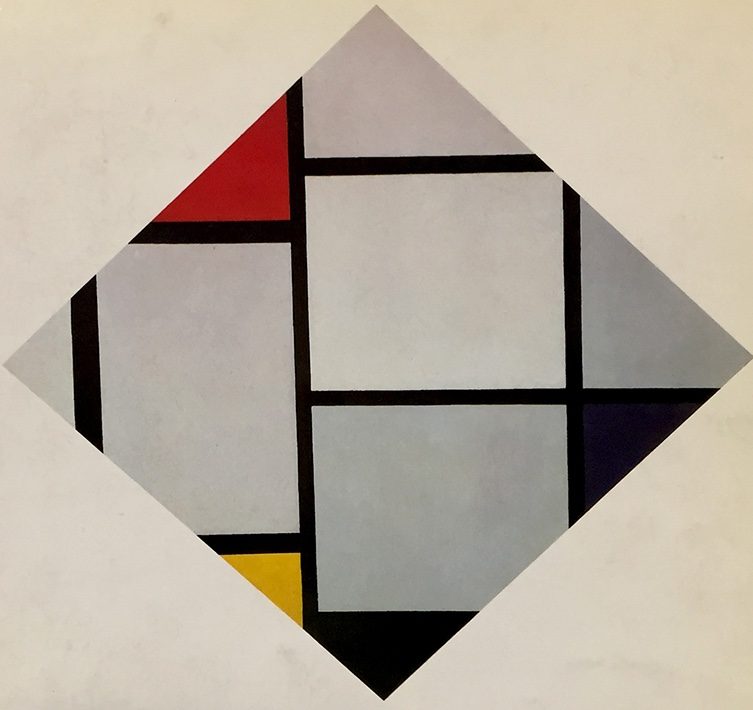
Is the sinking moon like a prisoner
sentenced somewhere to Black Water,
perhaps left hanged on the horizon
of an Andaman island? But here,
in Kashmir, by these waters,
its light will leave me—where?
My father is—in Persian—reciting
Hafiz of Shiraz, that “Nothing
in this world is without terrible
barriers— / Except love, but only when
it begins.” And the host fills
everyone’s glass again.
So what is separation’s geography?
Everything is just that mystery,
everything is this roar that deafens:
this stream has branched off from the Indus,
in Little Tibet, just to
find itself where Porus
miles down (there it will join the Jhelum)
lost to the Greeks. It will become,
in Pakistan, the Indus again.
Leaning against the Himalayas
(the mountains here are never
in the distance), wine-glass
in hand, I see evening come on. It is
two months since you left us. So this
is separation? Sharpened against
rocks, the stream, rapid-cutting the night,
finds its steel a little stained
with the beginning light,
and the moon must rise now from behind
that one pine-topped mountain to find
us without you. I stare at one guest
who is asking Father to fill them
in on—what else?—the future,
burnishing that dark gem
of Kashmir with a history of saints, with
prophecy, with kings, and with myth,
and I want them to change the subject
to these waters that must already
be silver there where the moon
sees the Indus empty
itself into the Arabian Sea. What
rustle of trees the wind forgot
reaches me through this roar as the moon,
risen completely, silvers the world
so ruthlessly, shining on
me a terror so pearled
Google Translate renders these lines as:
“Every building you see was disruptive
Except for love, it is free from defects.
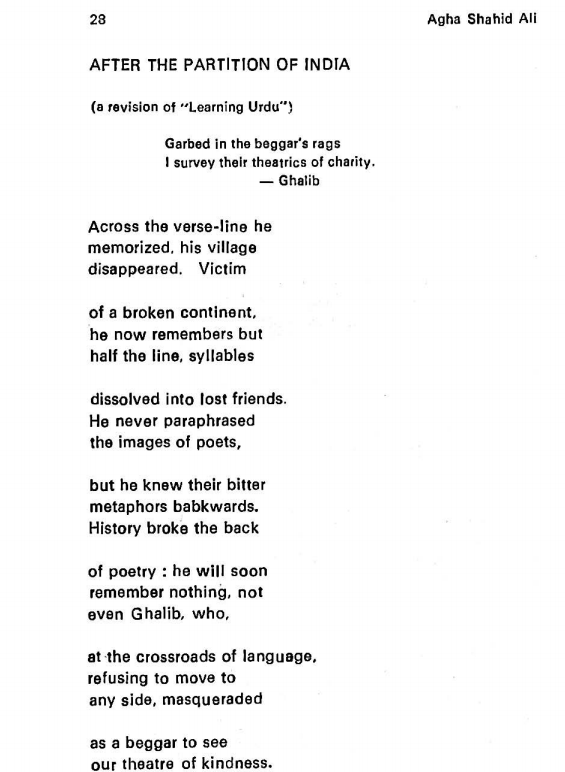
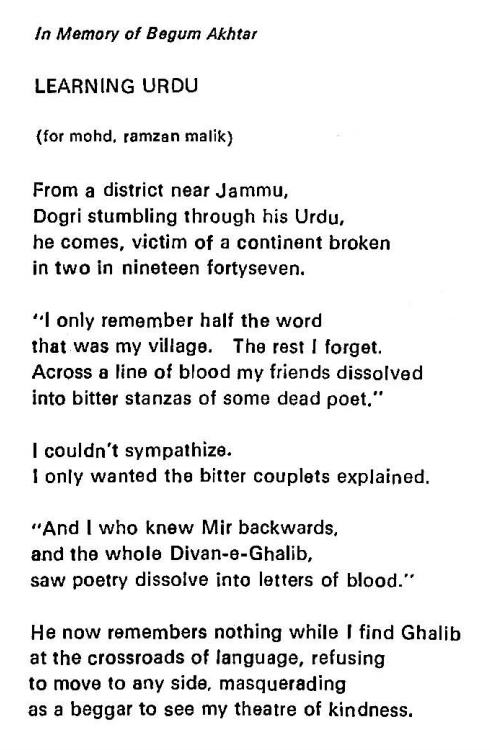

 Juvenilia