ash’aar raat yuuN dil meN terii khoii huuii yaad aaii jaise viraane meN chupke se bahaar aa jaae jaise sahraaoN meN haule se chale baad-e-nasiim jaise biimaar ko bevajah qaraar aa jaae
–Faiz Ahmed Faiz, with a hat tip to Mirza Ghalib:
un ke dekhe se jo aa jaatī hai muñh par raunaq vo samajhte haiñ ki bīmār kā haal achchhā hai
By V.G. Kiernan Poems By Faiz, p.49 Verses Last night your faded memory so came into the heart As spring comes in the wilderness quietly, As the zephyr moves slowly in deserts As rest comes without cause to a sick man
Last Night Last night your faded memory filled my heart Like spring’s calm advent in the wilderness, Like the soft desert footfalls of the breeze, Like peace somehow coming to one in sickness.
—
By Vikram Seth Mappings, Pg 43 Last night your faded memory came to me As in the wilderness spring comes quietly, As, slowly, in the desert, moves the breeze, As, to a sick man, without cause, comes peace.
—
By Daud Kamal The Unicorn and the Dancing Girl, Pg 28 The Curve of Memory Last night When I thought Of you All the deserts Became Fragrant With zephyrs. Spring Was everywhere And My dying heart Suddenly Came back To life.
—
By Shiv K. Kumar Faiz Ahmed Faiz: Selected Poems, Pg 3 Quatrain Last night a fugitive memory of you slid into my heart as though a wilderness was quietly touched by springtide, as though some breeze came soughing through a desert, as someone sick, for no reason, felt reclaimed
—
By Agha Shahid Ali Rebel’s Silhouette, Pg 3 Last Night At night my lost memory of you returned
and I was like the empty field where springtime, without being noticed, is bringing flowers;
I was like the desert over which the breeze moves gently, with great care;
I was like the dying patient who, for no reason, smiles.
August, 1947 ye daG-daG ujaalaa, ye shab-gaziidaa sahar wo intezaar tha jiskaa, ye wo sahar to nahii.n ye wo sahar to nahii.n jiskii aarzoo lekar chale the yaar ke: mil jayegi kahii.n na kahii.n falak ke dashth me.n taaro.n kii aakhirii manzil kahi.n to hogaa shab-e-sustmoujh kaa saahil kahi.n ti jake rukegaa safiin-e-gam-e-dil jawa.N lahuu kii pur asraar shahraaho.n se chale jo yaar to daaman pe kitne haath paDe dayaar-e-husn kii be-sabra khwaabgaaho.n se pukaarti rahii.n baahe.n, badan bulate rahe bahut azeez thii lekin ruKh-e-sahar kii lagan bahut karii.n tha hasiinane noor kaa daaman subuk-subuk thi tamanna dabi-dabi thi thakan sunaa hai ho bhi chukaa hai firaaq-e-zulmat-e-noor sunaa hai ho bhi chukaa hai wisaal-e-manzil-o-gaam badal chukaa hai bahut ahal-e-dard kaa dastoor nishaat-e-wasl halaal-o-azaab-e-hijr-e-haraam jigar kii aag, nazar kii umang, dil kii jalan kisii pe chaar:e-hijra.N kaa kuchch asar hii nahii.n kahaa.N se aayii nigaar-e-sabaa kidhhar ko gaii abhii chiraaG-e-sar-e-rah ko kuchch khabar hii nahii.n abhii garaanii-e-shab me.n kamii nahi.n aaii nazaat-e-deed’h-o-dil kii ghadii nahi.n aaii chale chalo ki wah ma.nzil abhi nahi.n aaii
–Faiz Ahmed Faiz, 14th August 1967
Rough draft by Sundeep Dougal, sometime in the 1980s.
The Dawn of Freedom, August 1947
This scarred, marred brightness, this bitten-by-night dawn – The one that was awaited, surely, this is not that dawn. This is not the dawn yearning for which Had we set out, friends, hoping to find sometime, somewhere The final destination of stars in the wilderness of the sky. Somewhere, at least, must be a shore for the languid waves of the night, Somewhere at least must anchor the sad boat of the heart. On the sensuous, secretive streets of young blood, When we set out, friends, who knows how many hands tugged at the sleeves From the impatient dreamlands of beauty’s pleasure-houses, Arms persistently reached out and bodies beckoned, But very dear was the longing for mere dawn, Very near was the hem of beauteous light: Desires, delicate and light; languor, suppressed and slight. It’s claimed that darkness and light are already separated, It’s claimed that the seeking and the sought have already united, That the lot of those who suffered has already changed a lot: The pleasure of union is allowed, torment of separation is banished. Fire in the belly, longing in the eyes, burning in the heart: None is affected at all by the anguish of separation From where came that sweet breeze and where it went, The street lamp has no inkling yet The heaviness of the night has not lifted yet The moment of salvation for the heart and the eyes has not arrived yet
Dasht-e-tanhaee maiN ai jaan-e-jahaaN larzaaN hai Teri aavaaz kay saaey, teray hontoN kay saraab Dasht-e-tanhaee maiN dooree kay khas-o-khaak talay Khil rahay haiN teray pehloo kay saman or gulaab
Uth rahee hai kaheeN qurbat say teri saaNs kee aanch Apnee khushboo maiN sulagti hooee madham madham Door ufaq paar chamaktee hooee qatra qatra Gir rahee hai teri dildaar nazar kee shabnam
Is qadar payaar say ai jaan-e-jahaaN rakha hai Dil kay rukhsaar pay is waqt teri yaad naiN haath YooN gumaaN hota hai gerchay hai abhee subh-e-firaaq Dhal gaya hijr ka din aa bhi gaee wasl ki raat
—
All translations are my rough first drafts compiled here for ease of reference.
Memory
In the wilderness of loneliness, O loved one, tremble Silhouettes of your voice, mirages of your lips In the wilderness of loneliness, under the straw and ash of distance Blosssom jasmines and roses of your nearness
From somewhere nearby, rises the warmth of your breath Smouldering in its scent leisurly, lingeringly Faraway, across the horizon, shining drop by drop Falls the dew of your heartmoving glance
So much with love, O loved one, has your memory placed Its hand, right now, on the face of my heart It seems, although it’s still the morning of parting, The day of separation is over, the night of meeting is here.
Much before he acquired fame for Umrao Jaan, Muzaffar Ali had served notice with Gaman, his debut film that here was someone with a deep understanding of poetry and music. The film is a landmark for giving the industry Farooq Sheikh, and perhaps the most-appreciated Suresh Wadkar song ever – Shahryar’s siine meiN jalan. The other haunting song was this, sung by Chhaya Ganguly, singing the poetry of Abu Sayeed Mohammad Makhdoom Mohiuddin Khudri, aka Makhdoom Mohiuddin.
आप की याद आती रही रात भर चश्म-ए-नम मुस्कुराती रही रात भर आप की याद आती रही …
रात भर दर्द की शमा जलती रही ग़म की लौ थरथराती रही रात भर …
बाँसुरी की सुरीली सुहानी सदा याद बनबनके आती रही रात भर …
याद की चाँद दिल में उतरती रही चाँदनी डगमगाती रही रात भर …
कोई दीवाना गलियों में फिरता रहा कोई आवाज़ आती रही रात भर …
The song had inspired a tribute when Makhdoom died in 1969, and Faiz wrote the following, appropriately titled, Makhdoom ki Yaad mein.
”aap kī yaad aatī rahī raat bhar”
chāñdnī dil dukhātī rahī raat bhar gaah jaltī huī gaah bujhtī huī sham-e-ġham jhilmilātī rahī raat bhar koī ḳhushbū badaltī rahī pairahan koī tasvīr gaatī rahī raat bhar phir sabā sāya-e-shāḳh-e-gul ke tale koī qissa sunātī rahī raat bhar jo na aayā use koī zanjīr-e-dar har sadā par bulātī rahī raat bhar ek ummīd se dil bahaltā rahā ik tamannā satātī rahī raat bhar
bahār aa.ī to jaise yak-bār lauT aa.e haiñ phir adam se vo ḳhvāb saare shabāb saare jo tere hoñToñ pe mar-miTe the jo miT ke har baar phir jiye the nikhar ga.e haiñ gulāb saare jo terī yādoñ se mushkbū haiñ jo tere ushshāq kā lahū haiñ ubal paḌe haiñ azaab saare malāl-e-ahvāl-e-dostāñ bhī ḳhumār-e-āġhosh-e-mah-vashāñ bhī ġhubār-e-ḳhātir ke baab saare tire hamāre savāl saare javāb saare bahār aa.ī to khul ga.e haiñ na.e sire se hisāb saare
बहार आई तो जैसे यकबार लौट आए हैं फिर अदम से वो ख़्वाब सारे शबाब सारे जो तेरे होंटों पे मर मिटे थे जो मिट के हर बार फिर जिये थे निखर गए हैं गुलाब सारे जो तेरी यादों में मुश्कबू हैं जो तेरे उश्शाक़ का लहू हैं उबल पड़े हैं अज़ाब सारे मलाल ए अहवाल दोस्तां भी ख़ुमार ए आग़ोश ए महवशां भी ग़ुबार ए ख़ातिर के बाब सारे तेरे हमारे सवाल सारे जवाब सारे बहार आई तो खिल गए हैं नए सिरे से हिसाब सारे
bahār aa.ī to jaise yak-bār
Spring is here as if suddenly
lauT aa.e haiñ phir adam se
back from nowhere are
vo ḳhvāb saare shabāb saare
all those dreams, all those beauties of youth
jo tere hoñToñ pe mar-miTe the
those who died longing for your lips
jo miT ke har baar phir jiye the
those who came alive every time after being destroyed
nikhar ga.e haiñ gulāb saare
all the roses glisten
jo terī yādoñ se mushkbū haiñ
those that are fragrant with the musk of your memory
jo tere ushshāq kā lahū haiñ those that are the lifeblood of your lovers
ubal paḌe haiñ azaab saare all the torments have boiled over
malāl-e-ahvāl-e-dostāñ bhī the anguish and apprehensions about friends
ḳhumār-e-āġhosh-e-mah-vashāñ bhī the intoxication of warm embraces in the beauty of the moon
ġhubār-e-ḳhātir ke baab saare in our dust of memories
tire hamāre
yours and mine
savāl saare javāb saare all the questions, all the answers
bahār aa.ī to khul ga.e haiñ have opened up again, with spring
na.e sire se hisāb saare all the old accounts anew
So my literal, almost word-by-word clunky translation with words looked up in the dictionary goes something like this:
Spring is here as if suddenly
back from nowhere
are all those dreams, all those beauties of youth
those who died longing for your lips
those who came alive every time after being destroyed
all these roses glisten
fragrant with the musk of your memory the lifeblood of your lovers all the torments have boiled over the anguish and apprehensions about friends the intoxication of warm embraces in the beauty of the moon in this dust of memories
yours and mine all the questions, all the answers have opened up again, with spring all the old accounts anew
(Hurried translation draft by SD)
Agha Shahid Ali takes liberties and transcreates this as follows:
It Is Spring, Again
It is spring, And the ledger is opened again. From the abyss where they were frozen, those days suddenly return, those days that passed away from your lips, that died with all our kisses, unaccounted. The roses return: they are your fragrance; they are the blood of your lovers. Sorrow returns. I go through my pain and the agony of friends still lost in the memory of moon-silver arms, the caresses of vanished women. I go through page after page. There are no answers, and spring has come once again asking the same questions, reopening account after account.
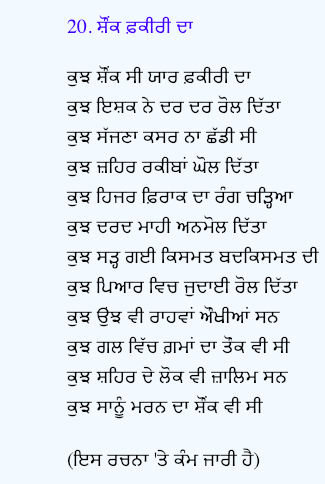
kis daa dosh sii kis daa nahin sii ae galaan hun karan diaan nahin veley lang gaye hun tauba waaley raataan hun hokey bharan diaan nahiin jo hoyaa tey honaa hii sii tey honiaan rokey rukdiaan nahiin ik varii jadon shuru ho jaavey tey gal phir awain mukdii nahin kujh unjh vii rawaan aukhiaan sii kujh gal wich gam daa tauq vii sii kujh shahar dey loq vii zaalim san kujh saanuu maran daa shauq vii sii
First rough draft: Sundeep Dougal
Whose fault was it, whose was it not There’s no point talking about it now The time to repent is now gone The nights now are not to sob What happened had to happen And what has to happen cannot be stopped And once it starts The topic does not end just like that As it is the path was not easy As it is the subject was subsumed by sadness As it is the people of the city were cruel As it is I had a death wish too.
Apparently there are more verses in this before the last four lines:
There was neither non-existence nor existence then; there was neither the realm of space nor the sky which is beyond. What stirred? Where? In whose protection? Was there water, bottomlessly deep?
सृष्टी से पहले सत् नहीं था, असत् भी नहीं अन्तरिक्ष भी नहीं, आकाश भी नहीं था छिपा था क्या? कहाँ? किसने ढका था? उस पल तो, अगम अतल जल भी कहाँ था?
न मृत्युरासीदमृतं न तर्हि न रात्र्या अह्न आसीत्प्रकेतः । आनीदवातं स्वधया तदेकं तस्माद्धान्यन्न परः किञ्चनास ॥२॥
There was neither death nor immortality then. There was no distinguishing sign of night nor of day. That one breathed, windless, by its own impulse. Other than that there was nothing beyond.
नहीं थी मृत्यू, थी अमरता भी नहीं नहीं था दिन, रात भी नहीं हवा भी नहीं, साँस थी स्वयमेव फिर भी नही था कोई कुछ भी, परमतत्त्व से अलग या परे भी।।
Darkness was hidden by darkness in the beginning; with no distinguishing sign, all this was water. The life force that was covered with emptiness, that one arose through the power of heat.
अंधेरे में अंधेरा-मुँदा अँधेरा था जल भी केवल निराकार जल था परमतत्त्व था सृजन-कामना से भरा, ओछे जल से घिरा, वही अपनी तपस्या की महिमा से उभरा ।।
Desire came upon that one in the beginning; that was the first seed of mind. Poets seeking in their heart with wisdom found the bond of existence in non-existence.
परम मन में बीज पहला जो उगा काम बनकर वह जगा कवियों ग्यानियों ने जाना असत् और सत् का निकट संबंध पहचाना ।।
Their cord was extended across. Was there below? Was there above? There were seed-placers; there were powers. There was impulse beneath; there was giving-forth above.
फैले संबंध के किरण धागे तिरछे परमतत्त्व उस पल ऊपर या नीचे? वह था बँटा हुआ, पुरुष और स्त्री बना हुआ ऊपर दाता वही भोक्ता, नीचे वसुधा स्वधा भोग्या ।।
को अद्धा वेद क इह प्र वोचत्कुत आजाता कुत इयं विसृष्टिः | अर्वाग्देवा अस्य विसर्जनेनाथा को वेद यत आबभूव ॥६॥
Who really knows? Who will here proclaim it? Whence was it produced? Whence is this creation? The gods came afterwards, with the creation of this universe. Who then knows whence it has arisen?
सृष्टी यह बनी कैसे? किससे? आई है कहाँ से? कोई क्या जानता है? बता सकता है? देवताओं को नहीं ग्यात, वे आए सृजन के बाद सृष्टी को रचां है जिसने, उसको जाना किसने? ।।
इयं विसृष्टिर्यत आबभूव यदि वा दधे यदि वा न | यो अस्याध्यक्षः परमे व्योमन्त्सो अङ्ग वेद यदि वा न वेद ॥७॥
Whence this creation has arisen – perhaps it formed itself, or perhaps it did not – the one who looks down on it, in the highest heaven, only he knows – or perhaps he does not know.
सृष्टी का कौन है कर्ता? कर्ता है वा अकर्ता? ऊँचे आकाश में रहता, सदा अध्यक्ष बना रहता वही सचमुच में जानता, या नहीं भी जानता है किसी को नहीं पता, नहीं पता, नहीं है पता ।।
HIRANYAGARBHA was present at the beginning; when born, he was the sole lord of created beings; he upheld this earth and heaven, –let us offer worship with an oblation to the divine KA.
था हिरण्य गर्भ सृष्टि से पहले विद्यमान . वोही तो सारे भूत जाती का स्वामी महान . जो है अस्तित्वमान धरती आसमान धारण कर. ऐसे किस देवता की उपासना करे हम हवी देकर?
vah thaa Hiranyagarbh shristi sey pehley vidyamaan vahi to saarey bhuut jaat ka swami mahaan jo hai astitvamaan dharti aasmaan dhaaran kar aisey kis devata ki upaasanaa karen hum havi dekar
– Rig Veda Rig Veda 10.121.1
येन द्यौरुग्रा पृथ्वी च दृढा येन स्वस्तभितं येननाकः । यो अन्तरिक्षे रजसो विमानः कस्मै देवाय हविषा विधेम ॥
yena dayaurugrā parthivī ca darḻhā yena sava satabhitaṃ yenanākaḥ | yo antarikṣe rajaso vimānaḥ kasmai devāyahaviṣā vidhema ||
By whom the sky was made profound and the earth solid, by Whom heaven and the solar sphere were fixed, who was the measure of the water in the firmament,- let us offer worship with an oblation to the divine KA
जिस के बल पर तेजोमय है अम्बर . पृथ्वी हरी भरी स्थापित स्थिर. स्वर्ग और सूरज भी स्थिर. ऐसे किस देवता की उपासना करे हम हवी देकर?
jiskey bal par taejomay hai ambar prithvi hari-bhari sthaapit-sthir swarg aur suuraj bhi sthir aisey kis devata ki upaasanaa karen hum havi dekar
āpo ha yada barhatīrviśvamāyana garbhaṃ dadhānājanayantīragnima | tato devānāṃ samavartatāsurekaḥkasmai devāya haviṣā vidhema ||
When the vast waters overspread the universe containing the germ and giving birth to AGNI, then was produced the one breath of the gods, – let us offer worship with an oblation to the divine KA.
गर्भ में अपने अग्नि धारण कर पैदा कर, व्याप था जल इधर उधर नीचे ऊपर, जगाचुके वो का एकमेव प्राण बनकर, ऐसे किस देवता की उपासना करे हम हवी देकर?
garbh mey apney agni dhaaran kar payda kar vyaapa thaa jal idhar-udhar neechey-ooper jaga jo devoon ka ekmayv praan ban kar aisey kis devata ki upaasanaa karen hum havi dekar
– Rig Veda 10.121.7
मा नो हिंसीज्जनिता यः पर्थिव्या यो वा दिवंसत्यधर्मा जजान । यश्चापश्चन्द्रा बर्हतीर्जजानकस्मै देवाय हविषा विधेम ॥
mā no hiṃsījjanitā yaḥ parthivyā yo vā divaṃsatyadharmā jajāna | yaścāpaścandrā barhatīrjajānakasmai devāya haviṣā vidhema ||
May he do us no harm who is the parent of the -earth, or who the unerring support (of the world) begat the heaven, and who generated the vast and delightful waters, – let us offer worship with an oblation to the divine KA.
ॐ ! सृष्टि निर्माता स्वर्ग रचयिता पूर्वज रखस कर. सत्य धर्म पालक अतुल जल नियामक रक्षा कर. फैली हैं दिशाएं बहु जैसी उसकी सब में सब पर, ऐसे ही देवता की उपासना करे हम हवी देकर, ऐसे ही देवता की उपासना करे हम हवी देकर.”
ho.. srishti nirmaata swarg rachayta poorvaj raksha kar satya dharm palak atul jal niyaamak raksha kar phaili hain dishaayen baahu jaisi uski submey subpar aisey hi devata ki upaasanaa karen hum havi dekar aisey hi devata ki upaasanaa karen hum havi dekar
न था कुछ तो ख़ुदा था कुछ न होता तो ख़ुदा होता डुबोया मुझ को होने ने न होता मैं तो क्या होता हुआ जब ग़म से यूँ बे-हिस तो ग़म क्या सर के कटने का न होता गर जुदा तन से तो ज़ानू पर धरा होता हुई मुद्दत कि ग़ालिब मर गया पर याद आता है वो हर इक बात पर कहना कि यूँ होता तो क्या होता

 Juvenilia