Faiz’s Ham DekheNge became an iconic song of dissent much later when Iqbal Bano made it into a song of open defiance against Zia-ul-Haq in Pakistan. But much before Zia came Ayub Khan. Hear it from Habib Jalib himself:
The cream of Pakistan was present in the mushaira, as Jalib recounts. A leaf would not move out of fear and he decided to read this. My translation is clunky and literal, done more for the sake of ensuring that I do get the meaning right.
diip jis kā mahallāt hī meñ jale chand logoñ kī ḳhushiyoñ ko le kar chale vo jo saa.e meñ har maslahat ke pale aise dastūr ko sub.h-e-be-nūr ko maiñ nahīñ māntā maiñ nahīñ jāntā
Whose lamp lights up only the palaces Walks along with the happiness of a few people That which grows in the shadow of every compromise Such tradition – that dawn without light I do not approve, I do not acknowledge
maiñ bhī ḳhā.if nahīñ taḳhta-e-dār se maiñ bhī mansūr huuñ kah do aġhyār se kyuuñ Darāte ho zindāñ kī dīvār se zulm kī baat ko jahl kī raat ko maiñ nahīñ māntā maiñ nahīñ jāntā
I am not afraid of the executioner’s scaffold Tell the strangers that I too am Mansoor, the martyr Why do you scare me with prison walls This oppressive diktat, this night of ignorance I do not approve, I do not acknowledge
phuul shāḳhoñ pe khilne lage tum kaho jaam rindoñ ko milne lage tum kaho chaak sīnoñ ke silne lage tum kaho is khule jhuuT ko zehn kī luuT ko maiñ nahīñ māntā maiñ nahīñ jāntā
Flowers are beginning to bloom on the branches, you say Drunkards are beginning to get their wineglasses, you say Cut up chests are beginning to get stitched, you say This open lie, this insult to intelligence I do not approve, I do not acknowledge
tum ne luuTā hai sadiyoñ hamārā sukūñ ab na ham par chalegā tumhārā fusūñ chārāgar dardmandoñ ke bante ho kyuuñ tum nahīñ chārāgar koī maane magar maiñ nahīñ māntā maiñ nahīñ jāntā
You have all stolen our peace of mind for centuries But your spell will not work on us now Why do you pretend to be a healer for those in pain You are no healer, even if some consider you to be one I do not approve, I do not acknowledge.
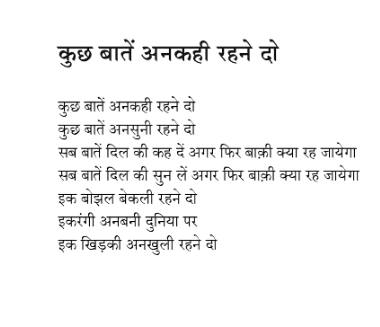
Let a few things remain unsaid Let a few things remain unheard If we say all that is in the heart What shall remain? If we heard all that is in the heart What shall remain? Let a heavy restlessness remain In a monochromatic incomplete world Leave one window remain unopened
. . . letters sent To dearest him that lives alas! away. – Gerard Manley Hopkins
1
Again I’ve returned to this country where a minaret has been entombed. Someone soaks the wicks of clay lamps in mustard oil, each night climbs its steps to read messages scratched on planets. His fingerprints cancel blank stamps in that archive for letters with doomed addresses, each house buried or empty
Empty? Because so many fled, ran away, and became refugees there, in the plains, where they must now will a final dewfall to turn the mountains to glass. They’ll see us through them see us frantically bury houses to save them from fire that, like a wall, caves in. The soldiers light it, hone the flames, burn our world to sudden papier-mâché
inlaid with gold, then ash. When the muezzin died, the city was robbed of every Call. The houses were swept about like leaves for burning. Now every night we bury our houses and theirs, the ones left empty. We are faithful. On their doors we hang wreaths. More faithful each night fire again is a wall and we look for the dark as it caves in.
2
We’re inside the fire, looking for the dark, one unsigned card, left on the street, says. I want to be he who pours blood. To soak your hands. Or I’ll leave mine in the cold till the rain is ink, and my fingers, at the edge of pain, are seals all night to cancel the stamps. The mad guide! The lost speak like this. They haunt a country when it is ash. Phantom heart,
pray he’s alive. I have returned in rain to find him, to learn why he never wrote. I’ve brought cash, a currency of paisleys to buy the new stamps, rare already, blank, to buy the new stamps, rare already, blank, no nation named on them. Without a lamp I look for him in houses buried, empty He may be alive, opening doors of smoke, breathing in the dark his ash-refrain:
Everything is finished, nothing remains. I must force silence to be a mirror to see his voice, ask it again for directions. Fire runs in waves. Should I cross that river? Each post office is boarded up. Who will deliver parchment cut in paisleys, my news to prisons? Only silence can now trace my letters to him. Or in a dead office the dark panes.
3
“The entire map of the lost will be candled. I’m keeper of the minaret since the muezzin died. Come soon, I’m alive. There’s almost a paisley against the light, sometimes white, then black. The glutinous wash is wet on its back as it blossoms into autumn’s final country— Buy it, I issue it only once, at night. Come before I’m killed, my voice canceled.”
In this dark rain, be faithful, Phantom heart,
this is your pain. Feel it. You must feel it. “Nothing will remain, everything’s finished,” I see his voice again: “This is a shrine of words. You’ll find your letters to me. And mine to you. Come soon and tear open these vanished envelopes.” And reach the minaret: I’m inside the fire. I have found the dark. This is your pain. You must feel it. Feel it, Heart, be faithful to his mad refrain— For he soaked the wicks of clay lamps, lit them each night as he climbed these steps to read messages scratched on planets. His hands were seals to cancel the stamps. This is an archive. I’ve found the remains of his voice, that map of longings with no limit.
4
I read them, letters of lovers, the mad ones, and mine to him from whom no answers came. I light lamps, send my answers, Calls to Prayer to deaf worlds across continents. And my lament is cries countless, cries like dead letters sent to this world whose end was near, always near. My words go out in huge packages of rain, go there, to addresses, across the oceans.
It’s raining as I write this. I have no prayer. It’s just a shout, held in, It’s Us! It’s Us! whose letters are cries that break like bodies in prisons. Now each night in the minaret I guide myself up the steps. Mad silhouette, I throw paisleys to clouds. The lost are like this: They bribe the air for dawn, this their dark purpose. But there’s no sun here. There is no sun here.
Then be pitiless you whom I could not save— Send your cries to me, if only in this way: I’ve found a prisoner’s letters to a lover— One begins: “These words may never reach you.” Another ends: “The skin dissolves in dew without your touch.” And I want to answer: I want to live forever. What else can I say? It rains as I write this. Mad heart, be brave.
– Agha Shahid Ali Parts 3 and 4 were added to this poem by Ali and he renamed the longer poem The country without a post office
TYou still haven’t called me a poet, Dear Sir, and I’ve been at it, this business of meanings, sometimes delayed,
selling words in bottles, at times in boxes.
I began with a laugh, stirred my tea with English, drank India down with a faint British accent, temples, beggars, and dust spread like marmalade on my toast:
A bitter taste: On Parliament Street a policeman beat a child on the head. Hermaphrodites walked by in Saffron saris,
their drums eching a drought-rhythm.
The Marxists said, In Delhi English sounds obscene. Return to Hindi or Bengali, eachword will burn like hunger.
A language must measure up to one’s native dust.
Divided between two cultures, I spoke a language foreign even to my ears; I diluted it in a glass of Scotch.
A terrible trade, my lip service to Revolution punctuated by a whisly-god.
Now collecting a degree in English, will I embrace my hungry country with an armful of soliloquies?
This trade in words continues however as Shakespeare feeds my alienation.
Please note, Dear Sir, my terrible plight as I collect rejection slips from your esteemed journal.
1. Between two saints he shares the earth, Mohammad Shah Rangeele (evoked in monsoon khayals). The beggar woman kisses the marble lattice, sobs and sobs on Khusro’ pillars. In a corner Jahanara, garbed in the fakir’s grass, mumbles a Sufi quatrain.
We recline on the gravestone, or on the saint’s poem, unaware of the sorrow of the pulverized prayer.
Time has only its vagrant finger. Knowing no equal, it pauses for massacres.
2 Suffering has its familiar patterns:
We buy flowers for Nizammudin’s feet, dream in the corner to the qawwal’s beat. The saint’s song chokes in his throat.
The poor tie prayers with threads, accutomed to their ancient wish for the milk and honey of Paradise.
3 I’ve learnt some lessons the easy way: I’ve seen so many, even a child somewhere, his infant bones hidden forever.
Stone, grass, children turned old: The dead have no ghosts.
4 These are time’s relics, its suffered epitaphs:
I come here to sing Khusro’s songs. I burn to the end of the lit essence as kings and beggars arise in the smoke:
That drunk debauched colourful king dances again with hoofs of sorrow
as Nadir skins the air with swords, horses galloping to the rhythm of a dying dynasty.
The muezzin interrupts the dawn, calls the faithful to prayer with a monster-cry:
Imagine: Once there was nothing here. Now look how minarets camouflage the sunset. Do you hear the call to prayer? It leaves me unwinding scrolls of legend till I reach the first brick they brought here. How the prayers rose, brick by brick?
Shahjahan knew the depth of stones, how they turn smooth rubbed on a heart. And then? Imprisoned with no consoling ghosts, bent with old age, while his cirgin daughter Jahanara dressed the cracked marble reign his skin kept up for so long.
ना मैं अन्दर बेद किताबां, ना विच भंगां ना शराबां, ना विच रिन्दां मसत खराबां, ना विच जागन ना विच सौण । बुल्ल्हा की जाणा मैं कौण ।
I am not in the Vedas or in the scriptures; I am not in drugs or in liquor. I am not among the drunken reprobates. I am not in waking, nor am I in sleep. Bullha, what do I know about who I am?
ना विच शादी ना ग़मनाकी, ना मैं विच पलीती पाकी, ना मैं आबी ना मैं ख़ाकी, ना मैं आतिश ना मैं पौण । बुल्ल्हा की जाणा मैं कौण ।
I am not in joy or in sadness, nor am I in pollution or purity. I am not of water or of earth, nor am I fire or air. Bullha, what do I know about who I am?
ना मैं अरबी ना लाहौरी, ना मैं हिन्दी शहर नगौरी, ना हिन्दू ना तुर्क पशौरी, ना मैं रहन्दा विच नदौण । बुल्ल्हा की जाणा मैं कौण ।
I am neither an Arab nor from Lahore, nor an Indian from the city of Nagaur. I am not a Hindu, nor a Turk from Peshawar. Nor do I live in Nadaun. Bullha, what do I know about who I am?
ना मैं भेत मज़हब दा पाइआ, ना मैं आदम हवा जाइआ, ना मैं आपना नाम धराइआ, ना विच बैठण ना विच भौण । बुल्ल्हा की जाणा मैं कौण ।
I have not discovered the secret of religion, nor am I born of Adam and Eve. I have not given myself a name, nor am I found in sitting or moving about. Bullha, what do I know about who I am?
अव्वल आखर आप नूं जाणां, ना कोई दूजा होर पछाणां, मैथों होर ना कोई स्याणा, बुल्हा शाह खढ़ा है कौण । बुल्ल्हा की जाणा मैं कौण ।
– Bulleh Shah Sufi Lyrics
translated byChristopher Shackle
Bullha, what do I know about who I am?
I know myself to be first and last, I do not recognise anyone else. No one is wiser than I am. Bullha, who is the lord standing here?
I am not a believer in the mosques, nor do I follow the rites of unbelief. I am not among the pure or the polluted. I am not Moses or Pharaoh.
I am not in the Vedas or in the scriptures; I am not in drugs or in liquor. I am not among the drunken reprobates. I am not in waking, nor am I in sleep . I am not in joy or in sadness, nor am I in pollution or purity. I am not of water or of earth, nor am I fire or air.
I am neither an Arab nor from Lahore, nor an Indian from the city of Nagaur. I am not a Hindu, nor a Turk from Peshawar. Nor do I live in Nadaun.
I have not discovered the secret of religion, nor am I born of Adam and Eve. I have not given myself a name, nor am I found in sitting or moving about.
I know myself to be first and last, I do not recognise anyone else. No one is wiser than I am. Bullha, who is the lord standing here?
naa main momn vich msitaan, naa main vich kufer diaan ritaan, naa main paakaan vich plitaan, naa main musaa naa fraun . bullhaa ki jaanaa main kaun .
naa main andr bed kitaabaan, naa vich bhngaaan naa shraabaan, naa vich rindaan mst khraabaan, naa vich jaagan naa vich saun . bullhaa ki jaanaa main kaun .
naa vich shaadi naa gaemnaaki, naa main vich pliti paaki, naa main aabi naa main khaki, naa main aatish naa main paun . bullhaa ki jaanaa main kaun .
naa main arbi naa laahauri, naa main hindi shhr ngaauri, naa hindu naa turk pshauri, naa main rhndaa vich ndaun . bullhaa ki jaanaa main kaun .
naa main bhet mjehb daa paaiaa, naa main aadm hvaa jaaiaa, naa main aapnaa naam dhraaiaa, naa vich baithn naa vich bhaun . bullhaa ki jaanaa main kaun .
avvl aakhr aap nun jaanaan, naa koi dujaa hor pchaanaan,
maithon hor naa koi syaanaa, bulhaa shaah khdha hai kaun .
bullhaa ki jaanaa main kaun .
To what purpose, April, do you return again? Beauty is not enough. You can no longer quiet me with the redness Of little leaves opening stickily. I know what I know. The sun is hot on my neck as I observe The spikes of the crocus. The smell of the earth is good. It is apparent that there is no death. But what does that signify? Not only under ground are the brains of men Eaten by maggots. Life in itself Is nothing, An empty cup, a flight of uncarpeted stairs. It is not enough that yearly, down this hill, April Comes like an idiot, babbling and strewing flowers.
 Juvenilia