Who was artificer at her creation?
Was it the moon, bestowing its own charm?
as it the graceful month of spring, itself
Compact with love, a garden full of flowers?
That ancient saint there, sitting in his trance,
Bemused by prayers and dull theology,
Cares naught for beauty: how could he create
Such loveliness, the old religious fool.
From Old Sanskrit | Ramayana
Blow, wind, to where my loved one is,
Touch her, and come and touch me soon:
I’ll feel her gentle touch through you
And meet her beauty in the moon.
These things are much for one who loves_
A man can live by them alone_
That she and I breathe the same air,
And the earth we tread is one.
From Old Sanskrit | Dandin
“Go if you must,” she said, ” and I shall pray
That Heaven may guard you on your way;
And I shall be reborn again, I swear,
Wherever you may be, my dear.”
From Old Sanskrit | Jayadeva
When the fever is caused by her looks and her voice,
The treatment of choice
Is a thrice-daily sip
Of her honey-sweet lip.
To avoid further harm,
And to keep the heart warm,
This follow-up treatment is known to be best:
The soothing and gentle warm touch of her breast.
(Professional secret, though_
Careful to keep it so!)
From Old Sanskrit | Bhartrhari
Of what use is the poet’s poem,
Of what use is the bowman’s dart,
Unless another’s senses reel
When it sticks quivering in the heart?
***
“Do not go”, I could say; but this is inauspicious
“All right go” is a loveless thing to say.
“Stay with me” is imperious. “Do as you wish” suggests
Cold indifference. And if I say I will die
When you are gone”, you might or might not believe me.
Teach me my husband, what I ought to say
When you go away.
***
Her face is not the moon, nor are her eyes
Twin lotuses, nor are her arms pure gold:
She’s flesh and bone. What lies the poets told!
Ah, but we love her, we believe the lies.
***
You are pale, friend moon, and do not sleep at night,
And day by day you waste away.
Can it be that you also
Think only of her as I do?
***
Destiny surely is unjust.
The bees it has decreed,
Shall feast on lotus-honey and sweet pollen-dust.
On water-weed
The geese must
Feed.
***
Philosphers are surely wrong to say
That attibutes in substance must inhere.
Her beauty burns my heart; yet I am here,
And she is far away.
***
A poet who has not tasted grief
Can mourn in fiction, and command belief.
A man who mourns in truth has no such art
To find words for a broken heart.
When he saw her,
He was struck by the arrows of love.
Nor could he save himself by shutting his eyes:
For he was a young man of an enquiring mind.
And so he was forced to examine the problem
In greater detail
Of how the Creator
Had come to make
A figure like hers.
***
Moonlight face,
Flower-bud hand,
Nectar voice,
Rose-red lip:
Stone-hard heart
***
If you can look into her wide black eyes
Unmoved, observe her laughing brows and keep
Your wits about you_I express surprise,
But honour you as you deserve, poor sheep.
***
Babur’s Writing Advice for Humayun | Vikram Seth
I have a quarrel with you. Your letters are
Illegible. They take hours to decode –
The writing crabbed, the style, too, somewhat strange.
(A riddle is not normally written in prose.)
The spelling is not bad (though *iltafaat*
Is spelt with *te* not *toeh*); yet even when read
The far-fetched diction you delight in veils
Your meaning.This is affectation. Write
From now on, clearly, using words that cost
Less torment to your reader and to you.”
From the Humble Administrator’s Garden, published in 1987
Fragment from “From the Babur-Nama, Memoirs of Babur, First Moghul Emperor of India”
[The passage, as it appears in Annette Susannah Beveridge’s translation, 1921:
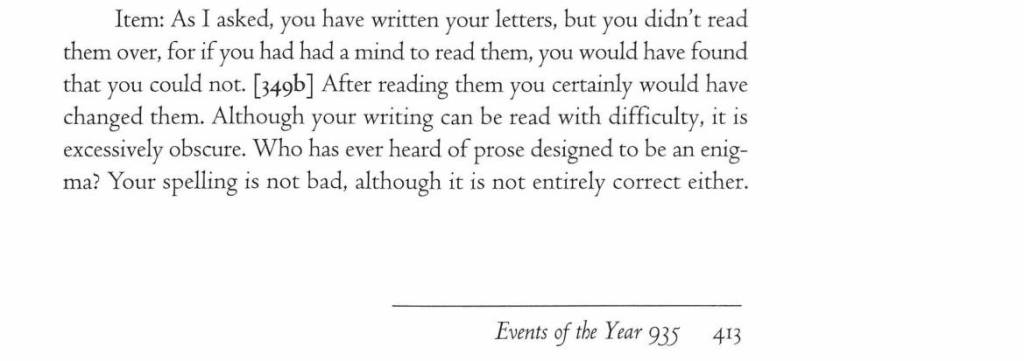
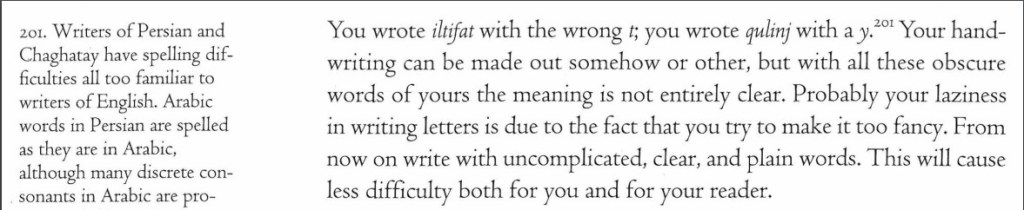
“Again, Thou hast written me a letter, as I ordered thee to do; but why not have read it over? If thou hadst thought of reading it, thou couldst not have done it, and, unable thyself to read it, wouldst certainly have made alteration in it. Though by taking trouble it can be read, it is very puzzling, and who ever saw an enigma in prose? Thy spelling, though not bad, is not quite correct; thou writest iltafāt with tā ( iltafāt ) and qūlinj with yā ( qīlinj ?). Although thy letter can be read if every sort of pains be taken, yet it cannot be quite understood because of that obscure wording of thine. Thy remissness in letter-writing seems to be due to the thing which makes thee obscure, that is to say, to elaboration. In future write without elaboration; use plain, clear words. So will thy trouble and thy reader’s be less.”
And the same passage, as it appears in Wheeler M. Thackston’s translation, 1996:
And the same passage, as it appears in Wheeler M. Thackston’s translation, 1996:
From California | Vikram Seth
Sunday night in the house.
The blinds drawn, the phone dead.
The sound of the kettle, the rain.
Supper: cheese, celery, bread.
For company, old letters
In the same disjointed script.
Old love wells up again,
All that I thought had slipped
Through the sieve of long absence
Is here with me again:
The long stone walls, the green
Hillsides renewed with rain.
The way you would lick your finger
And touch your forehead, the way
You hummed a phrase from the flute
Sonatas, or turned to say,
“Larches–the only conifers
That honestly blend with Wales.”
I walk with you again
Along these settled trails.
It seems I started this poem
So many years ago
I cannot follow its ending
And must begin anew.
Blame, some bitterness,
I recall there were these.
Yet what survives is Bach
And a few blackberries
Something of the “falling starlight”,
In the phrase of Wang Wei,
Falls on my shadowed self.
I thank you that today
His words are open to me.
How much you have inspired
You cannot know. The end
Left much to be desired.
“There is a comfort in
The strength of love.” I quote
Another favourite
You vouchsafed me. Please note
The lack of hope or faith:
Neither is justified.
I have closed out the night.
The random rain outside
Rejuvenates the parched
Foothills along the Bay.
Anaesthetised by years
I think of you today
Not with impassionedness
So much as half a smile
To see the weathered past
Still worth my present while.
Song ‘Coast Starlight’ | Vikram Seth
Some days I feel a sadness not of grief
The shadows lengthen on the earth’s relief
Salinas flows by like a silver shawl
A girl waves from the mission wall.
Research in Jiangsu Province | Vikram Seth
The Yangtse flows on like brown tape.
The research forms take final shape,
Each figure like a laden boat
With white or madder sails afloat.
Float on, float on, O facts and facts,
Distilled compendia of past acts,
Reveal the Grand Design to me,
Flotilla of my PhD.
At Evening | Vikram Seth
Let me now sleep, let me not think, let me
Not ache with inconsistent tenderness.
It was untenable delight; we are free–
Separate, equal–and if loverless,
Love consumes time which is more dear than love,
More unreplicable. With everything
Thus posited, the choice was clear enough
And daylight ratified our reckoning.
Now only movement marks the birds from the pines;
Now it’s dark; the blinded stars appear;
I am alone, you cannot read these lines
Who are with me when no one else is here,
Who are with me and cannot hear my voice
And take my hand and abrogate the choice.
 Juvenilia