I heard your name the other day Mentioned by someone in a casual way. She said she thought that you were looking great. A waiter passed by with a plate. She reached out for a sandwich, and your name Went back from where it came.
But like a serious owlet I stood there, Staring in mid-air. I frowned, then followed her around To hear, just once more, that sirenic sound – Those consonants, those vowels – what a fool! I show more circumspection as a rule.
I love you more than I can say. Try as I do, it hasn’t gone away. I hoped it would once, and I hope so still. Someday, I’m sure, it will. No glimpse, no news, no name will stir me then. But when? But when?
I smiled at you because I thought that you Were someone else; you smiled back; and there grew Between two strangers in a library Something that seems like love; but you loved me (If that’s the word) because you thought that I Was other than I was. And by and by We found we’d been mistaken all the while From that first glance, that first mistaken smile.
We are the last generations; Surdas, Bach,
Rembrandt, Du Fu, all life, love, work and worth
Will end in the particular rain; no ark
Will screen its force, no prayer procure rebirth.
The government of nations is assigned
Sage, journeyman and lunatic by rota;
A couple of toxic madmen sting mankind
Each century; we won’t escape the quota.
Dead planet of an unimportant star,
Beautiful earth, whose radiant creation
Became too radiant, no further war,
No suffering, frenzy or recrimination
Will litter your denatured crust or mar
Your deepening entropy with agitation.
The forms lie on the table, the paperclip removed.
The animal-cycle table is unfolded.
“What’s your name?” I ask the staring boy.
The boy carefully spits on the floor, and smiles.
His grandfather puffs at his Double Happiness cigarette
And thinks of cement and lintels; he and his son
Are building a house, and forms are outside his ken
But he is polite and describes his expenditures.
The accountant’s door faces panels of green
As yet untransplanted rice. Three women pass,
Bearing the harvested rape. The old man sighs
And says, “My second brother was a pig.”
“That makes him 45 years old”; I fill the space
With a Bic pen. The boy looks at it
With wonderment at its transparency.
A picture of Lady White Snake looks down from the wall.
The abacus clicks, a chicken strays into the room.
The old man says that the Japanese burnt and killed.
The accountant mentions the Guomindang conscriptions.
The boy has heard this before and strokes his chin.
A weasel runs along the embankment of the fields
And into the standing stalks. The golden goslings
Struggle into the pond. The oxen bolt
Towards the wheat despite the woman’s curses.
And there beyond the trees the Great River flows
And flows onwards and onwards and its rippled gold
Pours itself onwards past the mulberry hills
And the investigators and investigated and the black tiles
of roofs.
The shapes of things that are not here Appear, disperse, and reappear: A room, a face, a photograph, A book, a letter or a laugh, A turn of phrase or hand or mind, Ungiven gifts you’ve left behind, Each day recall themselves to me, Altered into reality.
Things that are here and were before, These too are altered at the core: This pen, this bunch of keys, this chair, The towel you used to dry your hair, The song you sang whose words I knew A year before I’d heard of you, Even these hands, that felt your touch, Though much the same, have altered much. O gracious moon, I recall how last year
This was a day that came and went.
I don’t know how the day was spent.
The sun rose up and reached its height.
The sun went down and it was night.
Somehow the hours that passed between
Dispersed as if they’d never been
Though I attended every one
Till both the day and I were done.
Sleepless, exhausted and perplexed,
Not knowing what is coming next,
I sense the stab of causeless fears,
The tedium of pointless tears.
Lonely, yet lacking will to find
One who could ease my limbs and mind,
I wait once more for faceless day
To blind the peaceless night away.
Maan looked at her with half-longing, half-laughing eyes. ‘I’ll arrange for the car,’ he said.
‘I’ll walk in the garden till then,’ said Saeeda Bai. ‘This is the most beautiful time of night. Just have this’—she indicated the harmonium—‘and the other things—sent back to my place tomorrow morning. Well, then,’ she continued to the five or six people left in the courtyard:
‘Now Mir takes his leave from the temple of idols— We shall meet again . . .’
Maan completed the couplet: ‘. . . if it be God’s will.’
He looked at her for an acknowledging nod, but she had turned towards the garden already.
Saeeda Bai Firozabadi, suddenly weary ‘of all this’ (but what was ‘all this’?) strolled for a minute or two through the garden of Prem Nivas. She touched the glossy leaves of a pomelo tree. The harsingar was no longer in bloom, but a jacaranda flower dropped downwards in the darkness. She looked up and smiled to herself a little sadly. Everything was quiet: not even a watchman, not even a dog. A few favourite lines from a minor poet, Minai, came to her mind, and she recited, rather than sang, them aloud:
‘The meeting has dispersed; the moths Bid farewell to the candlelight. Departure’s hour is on the sky. Only a few stars mark the night. . . .’
She coughed a little—for the night had got chilly all of a sudden—wrapped her light shawl more closely around her, and waited for someone to escort her to her own house, also in Pasand Bagh, no more than a few minutes away.
In ‘The Rivered Earth, Seth adds these:
What has remained will not remain: They too will quickly disappear. This is the world’s way, although we, Lost to the world, lie sleeping here.
I have a quarrel with you. Your letters are Illegible. They take hours to decode – The writing crabbed, the style, too, somewhat strange. (A riddle is not normally written in prose.) The spelling is not bad (though *iltafaat* Is spelt with *te* not *toeh*); yet even when read The far-fetched diction you delight in veils Your meaning.This is affectation. Write From now on, clearly, using words that cost Less torment to your reader and to you.”
From the Humble Administrator’s Garden, published in 1987 Fragment from “From the Babur-Nama, Memoirs of Babur, First Moghul Emperor of India”
[The passage, as it appears in Annette Susannah Beveridge’s translation, 1921:
“Again, Thou hast written me a letter, as I ordered thee to do; but why not have read it over? If thou hadst thought of reading it, thou couldst not have done it, and, unable thyself to read it, wouldst certainly have made alteration in it. Though by taking trouble it can be read, it is very puzzling, and who ever saw an enigma in prose? Thy spelling, though not bad, is not quite correct; thou writest iltafāt with tā ( iltafāt ) and qūlinj with yā ( qīlinj ?). Although thy letter can be read if every sort of pains be taken, yet it cannot be quite understood because of that obscure wording of thine. Thy remissness in letter-writing seems to be due to the thing which makes thee obscure, that is to say, to elaboration. In future write without elaboration; use plain, clear words. So will thy trouble and thy reader’s be less.”
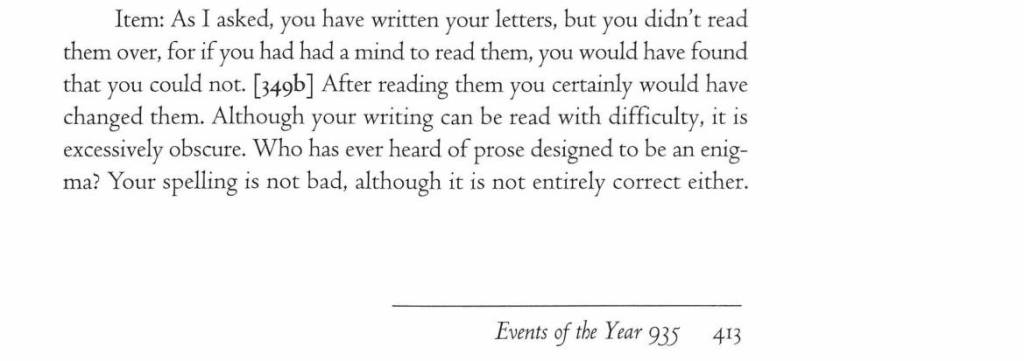
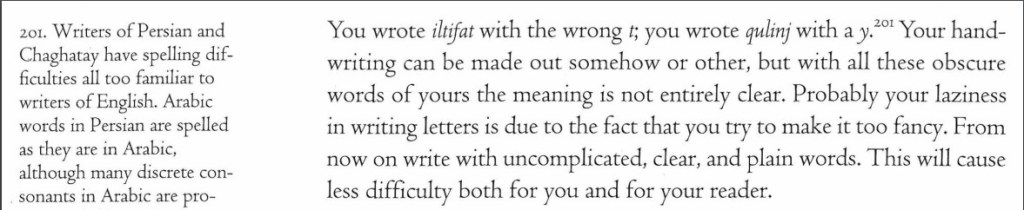
And the same passage, as it appears in Wheeler M. Thackston’s translation, 1996:
 Juvenilia