Mahfil barkhaast huii | The meeting has dispersed | Ameer Minai

mahfil barḳhāst hai patañge
ruḳhsat sham.oñ se ho rahe haiñ

hai kuuch kā vaqt āsmāñ par
taare kahīñ naam ko rahe haiñ

un kī bhī numūd hai koī dam
vo bhī na raheñge jo rahe haiñ

duniyā kā ye rang aur ham ko
kuchh hosh nahīñ hai so rahe haiñ

For the full ghazal, see here

This bit is from Vikram Seth’s A Suitable Boy:

Maan looked at her with half-longing, half-laughing eyes. ‘I’ll arrange for the car,’ he said.

‘I’ll walk in the garden till then,’ said Saeeda Bai. ‘This is the most beautiful time of night. Just have this’—she indicated the harmonium—‘and the other things—sent back to my place tomorrow morning. Well, then,’ she continued to the five or six people left in the courtyard:

‘Now Mir takes his leave from the temple of idols—
We shall meet again . . .’

Maan completed the couplet: ‘. . . if it be God’s will.’

He looked at her for an acknowledging nod, but she had turned towards the garden already.

Saeeda Bai Firozabadi, suddenly weary ‘of all this’ (but what was ‘all this’?) strolled for a minute or two through the garden of Prem Nivas. She touched the glossy leaves of a pomelo tree. The harsingar was no longer in bloom, but a jacaranda flower dropped downwards in the darkness. She looked up and smiled to herself a little sadly. Everything was quiet: not even a watchman, not even a dog. A few favourite lines from a minor poet, Minai, came to her mind, and she recited, rather than sang, them aloud:

‘The meeting has dispersed; the moths
Bid farewell to the candlelight.
Departure’s hour is on the sky.
Only a few stars mark the night. . . .’

She coughed a little—for the night had got chilly all of a sudden—wrapped her light shawl more closely around her, and waited for someone to escort her to her own house, also in Pasand Bagh, no more than a few minutes away.

In ‘The Rivered Earth, Seth adds these:

What has remained will not remain:
They too will quickly disappear.
This is the world’s way, although we,
Lost to the world, lie sleeping here.
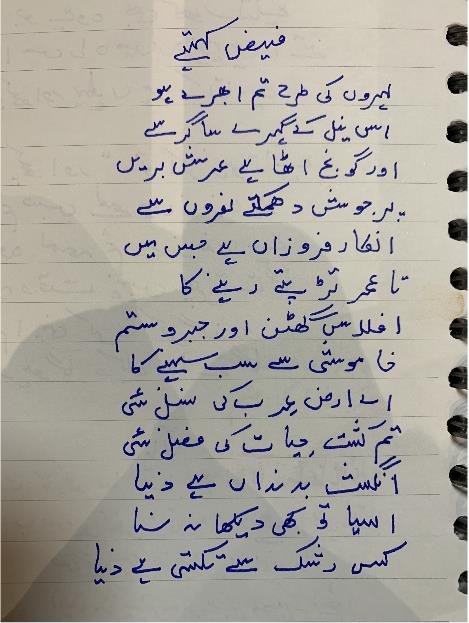
Faiz Kahte | Faiz would have said | Fahmida Riaz (recited by Dr Azra Raza)

lahron kii tarah tum ubhre ho
is niil ke gahre saagar se
aur guuNj uThaa hai arsh-e-bariiN*
purjosh** dhamakte naaroN se
inkaar farozaaN# hai jis meN
taa-umr taRapte rahne kaa
iflaas$, ghuTan aur jabr-o-sitam^
khaamoshi se sab sahne kaa
ae arz-e-arab& kii nasal naii
tum kisht-e-hayaat@ kii fasl naii
angusht badaNdaa hai duniya
aisaa to kahii dekhaa naa sunaa
kis rashk se taktii hai duniyaa

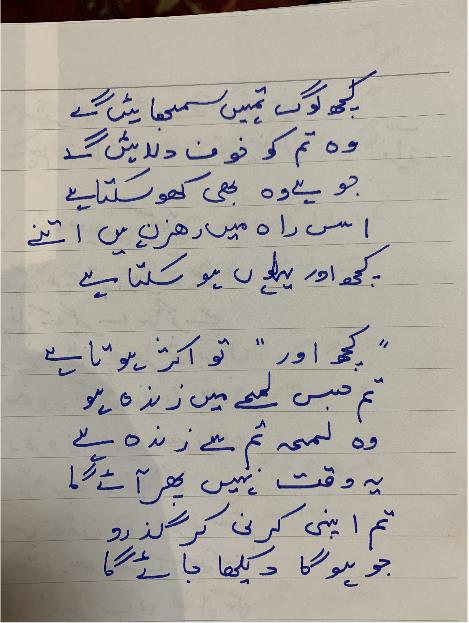
kuchh log tumheN samjhaayeNge
vo tum ko khaauf dilaayeNge
jo hai vo bhii kho saktaa hai
is raah meN rahzan haiN itne
kuchh aur yahaaN ho saktaa hai
kuchh aur to aksar hotaa hai
tum jis lamhe meN ziNdaa ho
vo lamhaa tum se ziNdaa hai
ye waqt nahii phir aayegaa
tum apnii karnii kar guzro
jo hogaa dekhaa jaayegaa

फ़ैज़ कहते
फ़हमीदा रिआज़

लेहरों की तरह तुम उभरे हो
इस नील के गहरे सागर से
और गूँज उठा है अर्श-ए-बरीं*
पुरजोश** धमकते नारों से
इनकार फ़रोज़ाँ# है जिस में
ता-उम्र तड़पते रहने का
इफ्लास$, घुटन और जब्र-ओ-सितम^
ख़ामोशी से सब सहने का
ऐ अरज़-ए-अरब& की नस्ल नई
तुम किश्त-ए-हयात@ की फ़स्ल नई
अंगुश्त बदंदां है दुन्या
ऐसा तो कभी देखा न सुना
किस रश्क से तकती है दुन्या

कुछ लोग तुम्हें समझाएं गे
वो तुमको ख़ौफ़ दिलाएं गे
जो है वो भी खो सकता है
इस राह में रहज़न हैं इतने
कुछ और यहाँ हो सकता है
कुछ और तो अक्सर होता है
तुम जिस लम्हे में ज़िंदा हो
वो लम्हा तुम से ज़िंदा है
ये वक़्त नहीं फिर आए गा
तुम अपनी करनी कर गुज़रो
जो होगा देखा जाए गा

*arsh-e-barii.n
अर्श-ए-बरींعرش بریں
highest sky/ throne of God
सबसे ऊँचा आसमान, नभ मण्डल,

**pur-josh
पुर-जोशپرجوش
Ardent, Lively, Wholehearted, Zealous
फा. वि. जोशीला, जोश से भरा हुआ, आवेगपूर्ण, ज़ोरदार, उत्साहपूर्ण, उमंग से भरा हुआ।

#farozaa.n
फ़रोज़ाँفروزاں
shining, luminous, resplendent

iflaas
इफ़्लासافلاس
poverty

^jabr-o-sitam
जब्र-ओ-सितमجبر و ستم
constraint and tyranny

&arz-e-arab
अर्ज़-ए-अरबارض عرب
Land of Arab

@kisht-e-hayaat
किश्त-ए-हयातکشت حیات
seeds sown, a sown field in life

“Angusht ba-dandaan”,
literally, “fingers between the teeth”.

I was quite puzzled by this as I could not find its meaning anywhere. I was happy to find Angushta in Platts but could not figure out what this “dandaan” was, till a friend helped, and finally the penny dropped” plural for daaNd, for teeth, as in Punjabi.

Norrnally, in Urdu and Hindi, one would expect to hear daaNt or daaNtoN – but daNdaan is so good, and so Punjabi!
As my friend Ajmal Kamal explained “This is one of the many common words between Persian and Punjabi. Persian, Punjabi and Dakkani have the same way of making plurals.”

***
There is a bit of history to this video – of this beautiful recitation by Dr Azra Raza. I came across a short video of her reciting this – which, as it turned out, were the concluding bits taken from her talk “Shahi and Faqeeri: Lahore at its best” at NYU Urdu Conference 2018 – and could not find the full Fahmida Riaz nazm anywhere in any of her published writings. 

I had of course known the original Faiz Ahmed Faiz poem that she had adapted as a tribute:

ab kyun us din kaa zikr karo
jab dil TukDe ho jaaega
aur saare gham miT jaaenge
jo kuchh paayaa kho jaaega
jo mil na saka wo paenge
ye din to wahii pahlaa din hai
jo pahlaa din thaa chaahat kaa
hum jis ki tamanna karte rahe
aur jis se har dam Darte rahe
ye din to kaii baar aaya
sau baar base aur ujaD gae
sau baar luTe aur bhar paayaa

ab kyuun us din kaa zikr karo
jab dil TukDe ho jaaega
aur saare gham miT jaaenge
tum KHauf-o-KHatar se dar-guzro
jo honaa hai so honaa hai
gar hasnaa hai to hasnaa hai
gar ronaa hai to ronaa hai
tum apnii karnii kar guzro
jo hogaa dekhaa jaegaa


Finally, it took an email to Dr Raza to get the full nazm. As Dr Raza explained, Fahmida Riaz wrote it for Arab Spring. But the lines she quoted of course speak for all times.

Apparently it was recited by her at a mushaairaa some years back at Asia Society in NY.

I do not accept, I do not acknowledge

Faiz’s Ham DekheNge became an iconic song of dissent much later when Iqbal Bano made it into a song of open defiance against Zia-ul-Haq in Pakistan. But much before Zia came Ayub Khan. Hear it from Habib Jalib himself:

The cream of Pakistan was present in the mushaira, as Jalib recounts. A leaf would not move out of fear and he decided to read this. My translation is clunky and literal, done more for the sake of ensuring that I do get the meaning right.

diip jis kā mahallāt hī meñ jale
chand logoñ kī ḳhushiyoñ ko le kar chale
vo jo saa.e meñ har maslahat ke pale
aise dastūr ko sub.h-e-be-nūr ko
maiñ nahīñ māntā maiñ nahīñ jāntā

Whose lamp lights up only the palaces
Walks along with the happiness of a few people
That which grows in the shadow of every compromise
Such tradition – that dawn without light
I do not approve, I do not acknowledge

maiñ bhī ḳhā.if nahīñ taḳhta-e-dār se
maiñ bhī mansūr huuñ kah do aġhyār se
kyuuñ Darāte ho zindāñ kī dīvār se
zulm kī baat ko jahl kī raat ko
maiñ nahīñ māntā maiñ nahīñ jāntā

I am not afraid of the executioner’s scaffold
Tell the strangers that I too am Mansoor, the martyr
Why do you scare me with prison walls
This oppressive diktat, this night of ignorance
I do not approve, I do not acknowledge

phuul shāḳhoñ pe khilne lage tum kaho
jaam rindoñ ko milne lage tum kaho
chaak sīnoñ ke silne lage tum kaho
is khule jhuuT ko zehn kī luuT ko
maiñ nahīñ māntā maiñ nahīñ jāntā

Flowers are beginning to bloom on the branches, you say
Drunkards are beginning to get their wineglasses, you say
Cut up chests are beginning to get stitched, you say
This open lie, this insult to intelligence
I do not approve, I do not acknowledge

tum ne luuTā hai sadiyoñ hamārā sukūñ
ab na ham par chalegā tumhārā fusūñ
chārāgar dardmandoñ ke bante ho kyuuñ
tum nahīñ chārāgar koī maane magar
maiñ nahīñ māntā maiñ nahīñ jāntā

You have all stolen our peace of mind for centuries
But your spell will not work on us now
Why do you pretend to be a healer for those in pain
You are no healer, even if some consider you to be one
I do not approve, I do not acknowledge.

Qawwali at Nizamuddin Aulia’s Dargah

1.
Between two saints he shares the earth,
Mohammad Shah Rangeele
(evoked in monsoon khayals).
The beggar woman kisses the marble lattice,
sobs and sobs on Khusro’ pillars.
In a corner Jahanara, garbed in the fakir’s grass,
mumbles a Sufi quatrain.

We recline on the gravestone,
or on the saint’s poem, unaware
of the sorrow of the pulverized prayer.

Time has only its vagrant finger.
Knowing no equal, it pauses for massacres.

2
Suffering has its familiar patterns:

We buy flowers for Nizammudin’s feet,
dream in the corner to the qawwal’s beat.
The saint’s song chokes in his throat.

The poor tie prayers with threads,
accutomed to their ancient wish
for the milk and honey of Paradise.

3
I’ve learnt some lessons the easy way:
I’ve seen so many, even a child somewhere,
his infant bones hidden forever.

Stone, grass, children turned old:
The dead have no ghosts.

4
These are time’s relics, its suffered epitaphs:

I come here to sing Khusro’s songs.
I burn to the end of the lit essence
as kings and beggars arise in the smoke:

That drunk debauched colourful king
dances again with hoofs of sorrow

as Nadir skins the air with swords,
horses galloping
to the rhythm
of a dying
dynasty.

The muezzin interrupts the dawn, calls
the faithful to prayer with a monster-cry:

We walk through streets calligraphed with blood.

– Agha Shahid Ali

The Jama Masjid Butcher

Urdu, bloody at his lips
and fingertips, in this
soiled lane of Jama Masjid,

is still fine, polished
smooth by the generations.

He doesn’t smile but
accepts my money
with a rare delicacy

as he hacks the rib of History.
His courtesy grazes

my well-fed skin

(he hangs this warm January morning
on the iron hook of prayer).

We establish the bond of phrases,
dressed in the couplets of Ghalib.

His life is this moment,
a century’s careful image.

– Agha Shahid Ali

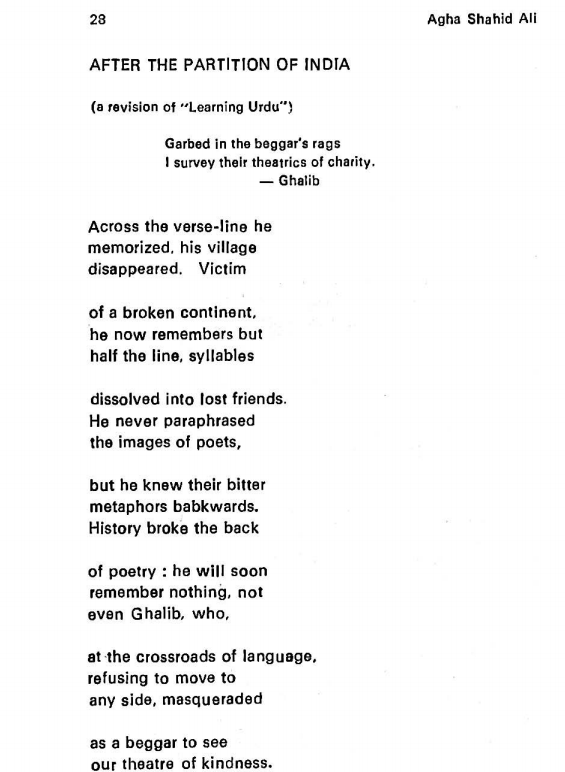
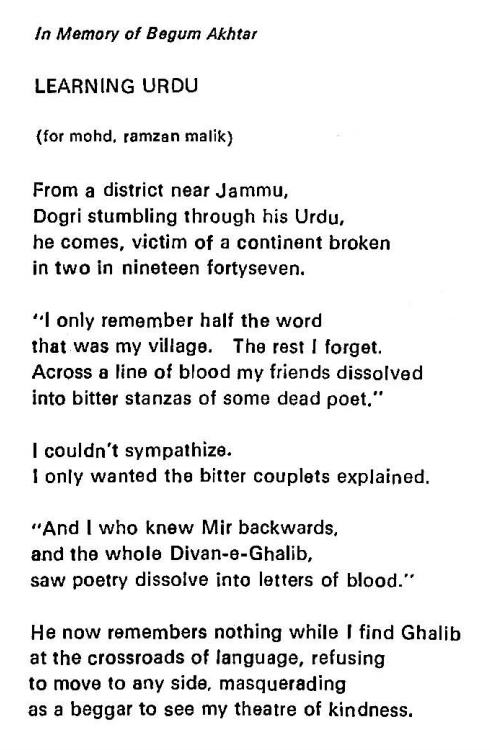
The above poem was later published in a revised and edited version as below:

The Butcher

In this lane
near Jama Masjid,*

where he wraps kilos of meat
in sheets of paper,

the ink of the news
stains his knuckles,

the script is wet
in his palms: Urdu,

bloody at his fingertips,
is still fine on his lips,

the language polished smooth
by knives

on knives. He hacks
the festival goats, throws

their skins to dogs.
I smile and quote

a Ghalib line; he completes
the couplet, smiles,

quotes a Mir line. I complete
the couplet.

He wraps my kilo of ribs.
I give him the money. The change

clutters our moment of courtesy,
our phrases snapping in mid-syllable,

Ghalib’s ghazals left unrhymed.

– Agha Shahid Ali
* Jama Masjid is the great mosque of Delhi. Ghalib and Mir, two of the greatest Urdu poets, are especially known for their ghazals.


dil jalaane ki baat karte ho

āshiyāne kī baat karte ho
dil jalāne kī baat karte ho
saarī duniyā ke ranj-o-ġham de kar
muskurāne kī baat karte ho
ham ko apnī ḳhabar nahīñ yaaro
tum zamāne kī baat karte ho
zikr merā sunā to chaḌh ke kahā
kis divāne kī baat karte ho
hādsa thā guzar gayā hogā
kis ke jaane kī baat karte ho

you talk of shelter
you talk of hurting the heart
after giving me a world of grief and sorrow
you ask me to smile
I have no clue about myself
and you talk about the world
when she heard a mention of me
she was irked and said:
Which madman do you talk of?
It was an accident and must have passed
whose departure do you talk of?