dil se to har mo.āmla kar ke chale the saaf ham kahne meñ un ke sāmne baat badal badal ga.ī
āḳhir-e-shab ke ham-safar ‘faiz’ na jaane kyā hue rah ga.ī kis jagah sabā sub.h kidhar nikal ga.ī
Agha Shahid Ali:
Ask no more about separation somehow I lived through its night The heart learned to console itself life returned to its routines.
*In the festival of memory you again were loveliness lit up by beauty the grief of the moon was extinguished we were again together in the night.
*When I remember you the morning is essence it is perfume it’s musk And the night when I kindle our sorrow is longing caught in itself
*The heart as such has settled its every doubt when I went to tell her we must part* but on seeing her the lips spoke love’s unrehearsed words and everything changed everything changed
It was the final night Faiz what happened to those who’d started out with you? When did the morning breeze abandon you and where on those last miles the dawn?
1978. Bhutto has been ousted. Zia-ul-Haq has taken over. Faiz is in exile again. And there is a Ghalib sh’r too, towards the end:
kahūñ kis se maiñ kih kyā hai shab-e ġham burī balā hai mujhe kyā burā thā marnā agar ek bār hotā
mire dil, mire musāfir huā phir se hukm sādir ki vatan-badar hoñ ham tum deñ galī galī sadā.eñ kareñ ruḳh nagar nagar, kā ki surāġh koī paa.eñ kisī yār-e-nāma-bar kā har ik ajnabī se pūchheñ jo patā thā apne ghar kā sar-e-kū-e-nā-shanāyāñ hameñ din se raat karnā kabhī is se baat karnā kabhī us se baat karnā tumheñ kyā kahūñ ki kyā hai shab-e-ġham burī balā hai hameñ ye bhī thā ġhanīmat jo koī shumār hotā hameñ kyā burā thā marnā agar ek baar hotā
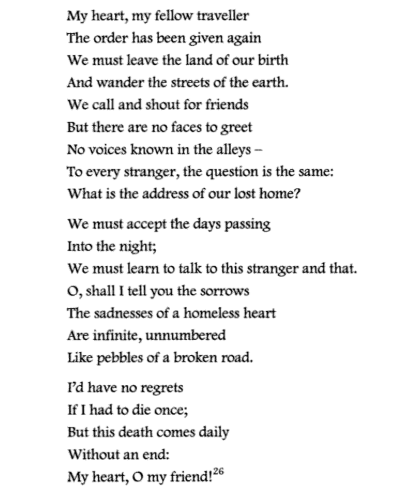
My heart, my fellow traveller It has been decreed again That you and I be exiled, go calling out in every street, turn to every town. To search for a clue of a messenger from our Beloved. To ask every stranger the way back to our home.
In this town of unfamiliar folk we drudge the day into the night Talk to this stranger at times, to that one at others.
How can I convey to you, my friend how horrible is a night of lonliness * It would suffice to me if there were just some count I would gladly welcome death if it were to come but once.
The title says it all. This was in 1974. A Pakistani goes to the newly-created Bangladesh.
ham ki Thahre ajnabī itnī mudārātoñ ke ba.ad phir baneñge āshnā kitnī mulāqātoñ ke ba.ad kab nazar meñ aa.egī be-dāġh sabze kī bahār ḳhuun ke dhabbe dhuleñge kitnī barsātoñ ke ba.ad the bahut bedard lamhe ḳhatm-e-dard-e-ishq ke thiiñ bahut be-mehr sub.heñ mehrbāñ rātoñ ke ba.ad dil to chāhā par shikast-e-dil ne mohlat hī na dī kuchh gile shikve bhī kar lete munājātoñ ke ba.ad un se jo kahne ga.e the ‘faiz’ jaañ sadqe kiye an-kahī hī rah ga.ī vo baat sab bātoñ ke ba.ad
Agha Shahid Ali’s Translation:
After those many encounters, that easy intimacy, . we are strangers now — After how many meetings will we be that close again?
When will we again see a spring of unstained green? After how many monsoons will the blood be washed . from the branches?
So relentless was the end of love, so heartless — After the nights of tenderness, the dawns were pitiless, . so pitiless.
And so crushed was the heart that though it wished . it found no chance — after the entreaties, after the despair — for us to . quarrel once again as old friends.
Faiz, what you’d gone to say, ready to offer everything, . even your life — those healing words remained unspoken after all else had . been said.
This has a line that the Hindi music lovers would recognise:
terii aankhoN ke sivaa duniyaa meN rakhaa kyaa hai?
A tip of the hat to Faiz by Sahir (Sahir has many responses to Faiz, including the famous one to subah-e-Azadi, with woh subah kabhi to aayegi).
This is the first overt instance of Faiz subverting traditional Urdu love oetry to “poetry with purpose”, poetry with social conscience pursuing social causes. And Faiz makes his intentions clear with a Persian epigram from Nizami: “Dil-e-bufro-khatm, jaan-e-khareedun” ( “I have sold my heart and bought a soul”).
mujh se pahlī sī mohabbat mirī mahbūb na maañg maiñ ne samjhā thā ki tū hai to daraḳhshāñ hai hayāt terā ġham hai to ġham-e-dahr kā jhagḌā kyā hai terī sūrat se hai aalam meñ bahāroñ ko sabāt terī āñkhoñ ke sivā duniyā meñ rakkhā kyā hai tū jo mil jaa.e to taqdīr nigūñ ho jaa.e yuuñ na thā maiñ ne faqat chāhā thā yuuñ ho jaa.e aur bhī dukh haiñ zamāne meñ mohabbat ke sivā rāhateñ aur bhī haiñ vasl kī rāhat ke sivā an-ginat sadiyoñ ke tārīk bahīmāna tilism resham o atlas o kamḳhāb meñ bunvā.e hue jā-ba-jā bikte hue kūcha-o-bāzār meñ jism ḳhaak meñ luThḌe hue ḳhuun meñ nahlā.e hue jism nikle hue amrāz ke tannūroñ se piip bahtī huī galte hue nāsūroñ se lauT jaatī hai udhar ko bhī nazar kyā kiije ab bhī dilkash hai tirā husn magar kyā kiije aur bhī dukh haiñ zamāne meñ mohabbat ke sivā rāhateñ aur bhī haiñ vasl kī rāhat ke sivā mujh se pahlī sī mohabbat mirī mahbūb na maañg
Naomi Lazard: Don’t ask me now, Beloved
Don't ask me now, Beloved, to love you as I did
when I believed life owed its luster to your existence.
The torments of the world meant nothing;
you alone could make me suffer.
Your beauty guaranteed the spring,
ordained its enduring green.
Your eyes were all there was of value anywhere.
If I could have you, fate would bow before me.
None of this was real; it was all invented by desire.
The world knows how to deal out pain,
apart from passion, and manna for the heart,
beyond the realm of love.
Warp and woof, the trappings of the rich
are woven by the brutish spell cast over all the ages;
human bodies numbed by filth, deformed by injuries,
cheap merchandise on sale in every street.
I must attend to this too: what can be done?
Your beauty still delights me, but what can I do?
The world knows how to deal out pain,
apart from passion, and manna for the heart,
beyond the realm of love.
Don't ask from me, Beloved,
love like that one long ago.
Victor Kiernen: Love, do not ask
Love, do not ask me for that love again
Once I thought life, because you lived, a prize —
The time's pain nothing, you alone were pain;
Your beauty kept earth's springtimes from decay,
My universe held only your bright eyes —
If I won you, fate would be at my feet.
It was not true, all this, but only wishing;
Our world knows other torments of love,
And other happiness than a fond embrace.
Dark curse of countless ages, savagery
Inwoven with silk and satin and gold lace,
Men's bodies sold in street and marketplace,
Bodies that caked grime fould sand thick blood smears.
Flesh issuing from the cauldrons of disease
With festered sores dripping corruption —
these Sights haunt me too, and will not be shut out;
Not be shut out, though your looks ravish still.
This world knows other torments than of love,
And other happiness than a fond embrace;
Love, do not ask for my old love again.


***

DO NOT ASK FROM ME, MY BELOVED,  LOVE LIKE THAT FORMER ONE

Do not ask from me, my beloved, love like that former one.
I had believed that you are, therefore life is shining;
There is anguish over you, so what wrangle is there over the  sorrow of the age?
From your aspect springtimes on earth have permanence;
What does the world hold except your eyes?
If you were to become mine, fate would be humbled,
—It was not so, I had only wished that it should be so.
There are other sufferings of the time [world)besides love,  There are other pleasures besides the pleasures of union.
The dark beastly spell of countless centuries,
Woven into silk and satin and brocade,
—  Bodies sold everywhere in alley and market,
Smeared with dust, washed in blood,
Bodies that have emerged from the ovens of diseases,
Pus flowing from rotten ulcers —
My glance comes back that way too: what is to be done?
Your beauty is still charming, but what is to be done?
There are other sufferings of the time (world) besides love,  There are other pleasures besides the pleasures of union;
Do not ask from me, my beloved, love like that former one.
Sarvat Rahman: Don’t ask me now, Beloved
Don’t ask me now, Beloved,
for that love of other days
When I thought since you were,
life would always scintillate
That love’s pain being mine,
the world’s pain I could despise.
That your beauty lastingness to the spring would donate,
That nothing in the world was of worth but your eyes;
Were you to be mine, fate would bow low before me.
It was not so; it was only my wish that it were so;
Other pains exist than those that love brings,
Other joys than those of lovers’ mingling.
Dark fearful talismans, come down the centuries,
Woven in silk and damask and cloth of gold;
Bodies that everywhere in streets are sold
Covered with dust, all their wounds bleeding.
Agha Shahid Ali: Don’t ask me for that love again
That which then was ours, my love,
don't ask me for that love again.
The world then was gold, burnished with light —
and only because of you.
That's what I had believed.
How could one weep for sorrows other than yours?
How could one have any sorrow but the one you gave?
So what were these protests, these rumours of injustice?
A glimpse of your face was evidence of springtime.
The sky, wherever I looked, was nothing but your eyes.
If You'd fall into my arms, Fate would be helpless.
All this I'd thought, all this I'd believed.
But there were other sorrows, comforts other than love.
The rich had cast their spell on history:
dark centuries had been embroidered on brocades and silks.
Bitter threads began to unravel before me
as I went into alleys and in open markets
saw bodies plastered with ash, bathed in blood.
I saw them sold and bought, again and again.
This too deserves attention.
I can't help but look back when I return from those alleys —what should one do?
And you still are so ravishing — what should I do?
There are other sorrows in this world, comforts other than love.
Don't ask me, my love, for that love again.
Mahmood Jamal: Do not ask of me, my love
Do not ask of me, my love, that love I once had for you.
There was a time when life was bright and young and blooming, and your sorrow was much more than any other pain.
Your beauty gave the spring everlasting youth:
your eyes, yes your eyes were everything,
all else was vain.
While you were mine, I thought, the world was mine.
Though now I know that it was not reality,
that's the way I imagined it to be;
for there are other sorrows in the world than love,
and other pleasures, too
Woven in silk and satin and brocade,
those dark and brutal curses of countless centuries:
bodies bathed in blood, smeared with dust,
sold from market-place to market-place,
bodies risen from the cauldron of disease,
pus dripping from their festering sores —
my eyes must also turn to these.
You’re beautiful still, my love,
but I am helpless too;
for there are other sorrows in the world than love,
and other pleasures too.
Do not ask of me, my love, that love I once had for you!
Shiv K Kumar: Ask me not for that old fervour, my love
Ask me not for that old fervour, my love.
I had then imagined that your love
would spark off my being,
counterpoise the giant agony of the world
that your beauty would bring
every spring to eternal blossom.
And what else was there to cherish but your eyes?
once you were mine would not fate itself bow to me?
I had only willed it all but it was not to be,
for there are sorrows other than heartache,
joys other than love’s rapture.
If there are spells of those dark,
savage, countless centuries
bodies robed in silk, satin and velvet
then aren’t there also bodies
traded down streets and alleyways
bodies smeared in dust, bathed in blood
bodies emerging from ovens of sickness
bodies with pus oozing from chronic sores?
If these images also seize my eye
even though your beauty still enthralls,
it’s because there are sorrows other than heartache,
joys other than love’s rapture
so ask me not for that old fervour, my love.
Daud Kamal: Do Not Ask
Do not ask me For that past love
When I thought you alone illumined this world
And because of you
The griefs of this world did not matter.
I imagined
Your beauty gave permanence to the colours of spring
And your eyes were the only stars in the universe.
I thought If I could only make you mine
Destiny would, forever, be in my hands.
Of course, it was never like this.
This was just a hope, a dream
Now I know There are afflictions
Which have nothing to do with desire
Raptures Which have nothing to do with love.
On the dark loom of centuries
Woven into silk, damask, and gold cloth
Is the oppressive enigma of our lives.
Everywhere — in the alleys and bazaars —
Human flesh is being sold —
Throbbing between layers of dust —
bathed in blood.
The furnace of poverty and disease
disgorges body after body —
Your beauty is still a river of gems but now I know
There are afflictions which have nothing to do with desire Raptures which have nothing to do with love.
My love, do not ask me ...
If dasht-e-tanhai is identified with the ghazal singer, this one is even more so. Faiz would often be asked to recite “wo Iqbal Bano wala – Ham Dekhenge”, perhaps the most overtly political nazms of his.
Zulfiqar Ali Bhutto was overthrown by Zia Ul-Haq in 1977 in a coup, who soon unleashed fascistic terror in the name of Nizam-e-Mustafa, thrusting his bigoted vision of fundamentalist Islam on Pakistan. Faiz was forced into exile in Beirut.
In 1979, Faiz turned to the Surah-e-rahman in the Quran to come up with the imagery – and the title – in which the description of qayamat, the Day of Reckoning is turned into the day of revolution.
It did not take much reading between the lines to understand that Faiz’s reading of the Quran had subversively invoked the “removal of idols from the Kaaba” and the “reinstallation of outlaws” to refer to the day of restoration of democracy and the ouster of Zia.
Iqbal Bano’s singing of this immediately turned the nazm into an articulation of defiant protest. Faiz died in 1984. By then the sari too had been banned by Haq’s puritanical regime. On his first death anniversary in 1985, Iqbal Bano turned up in a black sari to sing the song that had already become an iconic anthem, rousing the Lahore audience to start chanting ‘Inquilaab zindabad’. The military intelligence that was monitoring the concert cut off electricity, but Iqbal Bano sang on defiantly, her voice reaching a crescendo, eventually facing the wrath of the brutal regime that severely restricted her performances thereafter.
ham dekheñge lāzim hai ki ham bhī dekheñge vo din ki jis kā va.ada hai jo lauh-e-azal meñ likhkhā hai jab zulm-o-sitam ke koh-e-girāñ ruuī kī tarah uḌ jā.eñge ham mahkūmoñ ke pāñv-tale jab dhartī dhaḌ-dhaḌ dhaḌkegī aur ahl-e-hakam ke sar-ūpar jab bijlī kaḌ-kaḌ kaḌkegī jab arz-e-ḳhudā ke ka.abe se sab but uThvā.e jā.eñge ham ahl-e-safā mardūd-e-haram masnad pe biThā.e jā.eñge sab taaj uchhāle jā.eñge sab taḳht girā.e jā.eñge bas naam rahegā allāh kā jo ġhā.eb bhī hai hāzir bhī jo manzar bhī hai nāzir bhī uTThegā anal-haq kā na.ara jo maiñ bhī huuñ aur tum bhī ho aur raaj karegī ḳhalq-e-ḳhudā jo maiñ bhī huuñ aur tum bhī ho
First rough draft: Sundeep Dougal
We shall witness It is imperative that we too shall witness The day that has been promised That has been written in the tablet of eternity When the heavy mountains of tyranny Will blow away like cotton When under the feet of the oppressed the earth shall shake with loud thuds When over the heads of the rulers The lightning will crackle uproariously When from the abode of God All the idols shall be removed We the pure who have been kept out of the sacred places Shall be seated on the high cushions When the crowns would be knocked off And the thrones overturned Only the name of God will remain Which is absent too and present too Which is spectacle too and spectator too As the slogan of I-am-Truth is raised That is me too and so are you too And the creation of God shall rule That is me too and so are you too
aaiye haath uThaayeN ham bhii ham jinheN rasm-e-du’aa yaad nahiiN ham jinheN soz-e-muhabbat ke sivaa ko’ii but, ko’ii Khudaa yaad nahiiN
aaiye arz guzaareN ke nigaar-e-hastii zehr-e-imroz meN shiiriini-e-fardaa bhar de voh jinheN taab-garaaN-baarii-e-ayyaam nahiiN un ki palkoN pe shab-o-roz ko halkaa kar de
jin kii aaNkhoN ko rukh-e-subh kaa yaaraa bhii nahiiN un kii raatoN meN ko’ii shamaa munavvar kar de jin ke qadmoN ko kisii rah ka sahaara bhii nahiiN un kii nazroN pe ko’ii raah ujaagar kar de
jinkaa diiN pairavi-e-kazbo-riyaa hai un ko himmat-e-kufr mile, jurrat-e-tehqiiq mile jin ke sar muntazir-e-tegh-e-jafaa haiN un ko dast-e-qaatil ko jhaTak dene ki taufiiq mile
ishq ka sarr-e-nihaaN jaan tapaaN hai jis se aaj iqraar kareN aur tapish miT jaaye harf-e-haq dil meiN khaTakta hai jo kaNTe kii tarah aaj izhaar kareN or khalish miT jaaye
Faiz Ahmed Faiz 14th August 1967
Rough draft Prayer
Come, let us too lift our hands We, who do not remember the custom of prayer We, who other than the fire of love, Do not recall any idol, any god
Come, let us pray that the beloved, life Suffuses tomorrow’s sweetness into today’s poison Makes day and night sit lightly on the eyelashes Of those who don’t have the strength to bear the burden of time
Those, who can’t see the face of dawn May a flame light up their nights Those, whose steps aren’t aided by a path May a way ahead be illumined to their eyes
Those who believe in justifying deceit and hypocrisy May they get the courage to defy, the daring to seek May those whose heads await the sword of tyrrany Get the strength to snap away the hand of the murderer
The hidden secret of love which has inflamed the soul: Today own up to it; let the fever abate The word of truth that pricks the heart like a thorn Accept it today so that this piercing anxiety is gone
tum jo naa aa’e the to har chiiz vahii thii kih jo hai aasmaaN hadd-e-nazar, raahguzar raahguzar, shiishaah-e-mai, shiishaah-e-mai aur ab shiishaah-e-mai, raahguzar, rang-e-falak rang hai dil kaa mire, “xuun-e-jigar hone tak” champaa’i rang kabhii, raahat-e-diidaar kaa rang sur’ma’ii rang kabhii, saa’at-e-bezaar kaa rang zard pattoN kaa xas-o-xaar kaa rang surkh phuuloN kaa, dahakte hu’e gulzaar kaa rang zahar kaa rang, lahuu rang. shab-e-taar kaa rang aasmaaN, rahguzar, shiishaah-e-mai koii bhiigaa hu’aa daaman, ko’ii dukhtii hu’ii rag ko’ii har lahzaah badaltaa hu’aa aa’iinaah hai
ab jo aa’e ho to Thahro kih koii rang, koii rut ko’ii shai ek jagah par Thahre phir se ik baar har ik chiiz vahii ho ke jo hai aasmaaN hadd-e-nazar, rahguzar rahguzar, shiishaah-e-mai, shiishaah-e-mai
Before you came everything was what it is: the sky the limit of sight the road a road, the glass of wine a glass of wine. And now the glass of wine, the road, the color of the sky are the color of my heart while it breaks itself down into blood. Sometimes a gold color—a color of eyes’ delight that sooty color, the color of disgust the color of dry leaves, straw, thorns the color of red flowers in a blazing garden poison color, blood color, the color of black night. The sky, the road, the glass of wine are a sodden cloak, an aching vein, a mirror changing every moment.
Now that you’ve come, stay—let some color, season, thing stay in place. One more time let everything be what it is: the sky the limit of sight the road a road, the glass of wine a glass of wine.
—
By Victor Kiernan Poems by Faiz Pg 252-255
Before You Came
Before you came, all things were what they are— The sky sight’s boundary, the road a road, The glass of wine a glass of wine; since then, Road, wineglass, colour of heaven, all have taken The hues of this heart ready to melt into blood— Now golden, as the solace of meeting is, Now grey, the livery of despondent hours, Or tint of yellowed leaves, of garden trash, Or scarlet petal, a flowerbed all ablaze: Colour of poison, colour of blood, or shade Of sable night. Sky, highroad, glass of wine— The first a tear-stained robe, the next a nerve Aching, the last a mirror momently altering…. Now you have come, stay here, and let some colour, Some month, some anything, keep its own place, And all things once again be their own selves, The sky sight’s bound, the road a road, wine wine.
—
By Naomi Lazard The True Subject Pg 32-35
Before You Came Before you came things were just what they were: the road precisely a road, the horizon fixed, the limit of what could be seen, a glass of wine was no more than a glass of wine.
With you the world took on the spectrum radiating from my heart: your eyes gold as they open to me, slate the color that falls each time I lost all hope.
With your advent roses burst into flame: you were the artist of dried-up leaves, sorceress who flicked her wrist to change dust into soot. You lacquered the night black.
As for the sky, the road, the cup of wine: one was my tear-drenched shirt, the other an aching nerve, the third a mirror that never reflected the same thing.
Now you are here again—stay with me. This time things will fall into place; the road can be the road, the sky nothing but sky; the glass of wine, as it should be, the glass of wine.
—
By Agha Shahid Ali The Rebel’s Silhouette Pg 56-57
Before You Came Before you came, things were as they should be: the sky was the dead-end of sight, the road was just a road, wine merely wine.
Now everything is like my heart, a color at the edge of blood: the grey of your absence, the color of poison, or thorns, the gold when we meet, the season ablaze, the yellow of autumn, the red of flowers, of flames, and the black when you cover the earth with the coal of dead fires.
And the sky, the road, the glass of wine? The sky is a shirt wet with tears, the road a vein about to break, and the glass of wine a mirror in which the sky, the road, the world keep changing.
Don’t leave now that you’re here— Stay. So the world may become like itself again: so the sky may be the sky, the road a road, and the glass of wine not a mirror, just a glass of wine.
—
By Shiv K. Kumar Faiz Ahmed Faiz: Selected Poems pg 126-127
The Colour of the Moment Before you came, everything was what it is— the sky, vision-bound the pathway, the wine-glass. And now the wine-glass, the pathway, the sky’s tint— everything bears the colour of my heart till all melts into blood. Sometimes the golden tinge, sometimes the hue of the joy of seeing you, sometimes ashen, the shade of the dreary moment— the colour of yellow leaves, of thorn and trash, of the crimson petals of the flower-beds aglow, the tint of poison, of blood, of sable night. The sky, the pathway, the wine-glass— some tear-stained robe, some wincing nerve, some ever-revolving mirror.
Now that you’re here, stay on so that some colour, some season, some object may come to rest and once again everything may become what it was— the sky, vision-bound, the pathway, the wine-glass.
ash’aar raat yuuN dil meN terii khoii huuii yaad aaii jaise viraane meN chupke se bahaar aa jaae jaise sahraaoN meN haule se chale baad-e-nasiim jaise biimaar ko bevajah qaraar aa jaae
–Faiz Ahmed Faiz, with a hat tip to Mirza Ghalib:
un ke dekhe se jo aa jaatī hai muñh par raunaq vo samajhte haiñ ki bīmār kā haal achchhā hai
By V.G. Kiernan Poems By Faiz, p.49 Verses Last night your faded memory so came into the heart As spring comes in the wilderness quietly, As the zephyr moves slowly in deserts As rest comes without cause to a sick man
Last Night Last night your faded memory filled my heart Like spring’s calm advent in the wilderness, Like the soft desert footfalls of the breeze, Like peace somehow coming to one in sickness.
—
By Vikram Seth Mappings, Pg 43 Last night your faded memory came to me As in the wilderness spring comes quietly, As, slowly, in the desert, moves the breeze, As, to a sick man, without cause, comes peace.
—
By Daud Kamal The Unicorn and the Dancing Girl, Pg 28 The Curve of Memory Last night When I thought Of you All the deserts Became Fragrant With zephyrs. Spring Was everywhere And My dying heart Suddenly Came back To life.
—
By Shiv K. Kumar Faiz Ahmed Faiz: Selected Poems, Pg 3 Quatrain Last night a fugitive memory of you slid into my heart as though a wilderness was quietly touched by springtide, as though some breeze came soughing through a desert, as someone sick, for no reason, felt reclaimed
—
By Agha Shahid Ali Rebel’s Silhouette, Pg 3 Last Night At night my lost memory of you returned
and I was like the empty field where springtime, without being noticed, is bringing flowers;
I was like the desert over which the breeze moves gently, with great care;
I was like the dying patient who, for no reason, smiles.
 Juvenilia